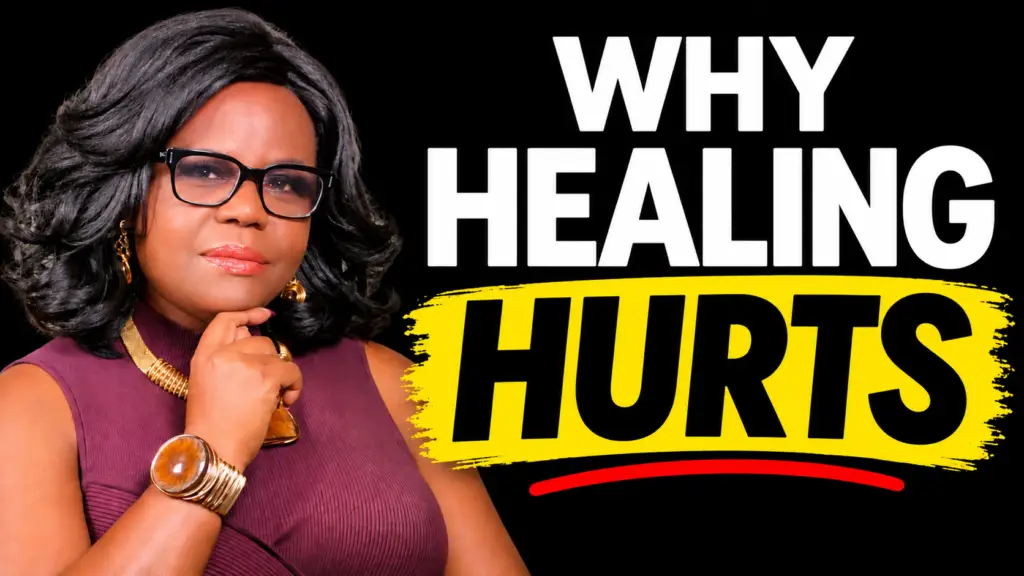
Why healing feels harder. Have you ever started your healing journey only to wonder why you suddenly feel worse?
Maybe you finally started therapy, began setting healthy boundaries, stopped people-pleasing, or decided to confront childhood trauma. You expected peace, clarity, and emotional freedom. Instead, you find yourself crying more, remembering painful experiences, or questioning who you are.
You might even ask yourself, Why do I feel worse now that I’m finally doing the work?
Here’s what I want you to understand: Feeling uncomfortable during emotional healing doesn’t automatically mean you’re going backward. Sometimes, becoming more aware of emotions you’ve avoided can make the early stages of healing feel harder.
Healing from trauma is not always a straight line toward happiness. It can involve grief, uncertainty, emotional vulnerability, and the difficult process of letting go of survival patterns that once protected you.
In this episode of 5 Minute Fridays with Coach Myrna on the Transform Your Mind podcast, we’re exploring why healing feels harder before it gets better, how trauma can shape your identity, and why the uncomfortable middle of your healing journey deserves compassion rather than judgment.
Why Healing Feels Worse Before It Gets Better (The Truth About Trauma Recovery)
Why Does Healing Feel Harder Before It Gets Better?
One of the biggest misconceptions about emotional healing is that it should feel good immediately.
We imagine that once we decide to heal, peace will follow. We expect that going to therapy, practicing forgiveness, setting boundaries, or developing a stronger spiritual life will automatically make us happier.
But healing doesn’t always work that way.
Sometimes, healing begins with awareness.
You become aware of how much pain you’ve been carrying. You recognize relationships that have been unhealthy. You notice patterns of people-pleasing, emotional suppression, or perfectionism that you’ve practiced for years.
You begin questioning behaviors that once felt normal.
That awareness can be uncomfortable because you can no longer ignore what you’ve discovered.
For some people, the beginning of trauma recovery feels like losing the emotional protection they relied on for years.
But awareness is not the same as regression.
Sometimes, healing feels harder because you’re finally paying attention to what needs your care.

1. Healing Can Make You Feel Again After Years of Emotional Numbness
I once coached a client who said something that stopped me in my tracks.
She said, “I think I was happier before I started working with you on this healing journey. At least I wasn’t crying all the time.”
That statement revealed something important about the way we sometimes misunderstand healing and why healing feels harder.
Before beginning her emotional healing journey, this client had learned to stay busy. She avoided silence and uncomfortable conversations.
She pushed through difficult emotions because she believed being strong meant never allowing herself to fall apart.
She wasn’t experiencing much joy, but she also wasn’t allowing herself to acknowledge much pain.
She had become emotionally numb.
When we began working together, she started recognizing emotions she had previously suppressed.
And yes, at first, those feelings were heavy.
But months later, she told me something completely different.
“I can laugh now, and it reaches my eyes. I didn’t even realize how long I had been numb.”
That was a beautiful moment.
Healing hadn’t simply introduced sadness into her life. It had helped her reconnect with a wider range of emotions.

Emotional Numbness Is Sometimes a Survival Response
Emotional numbness can develop when people experience overwhelming stress, trauma, or prolonged emotional pain.
Instead of processing difficult feelings, healing feels harder because they disconnect from their feelings or focus intensely on work, caregiving, achievement, or other responsibilities.
For some people, this emotional distance becomes a way of coping.
The problem is that disconnecting from painful emotions can also make it harder to experience joy, connection, and vulnerability.
As emotional awareness increases, previously avoided feelings may become more noticeable.
This doesn’t mean everyone must cry to heal. Some people cry frequently, while others process emotions differently.
The important question isn’t whether you’re crying.
It’s whether you’re gradually developing a healthier relationship with your emotions.
Healing feels harder because it isn’t about forcing yourself to feel pain. It’s about learning that you can acknowledge your feelings without being controlled by them.
2. Healing Often Feels Like Loss Before It Feels Like Freedom
One of my favorite ways to explain emotional healing is through the process of excavation.
Imagine you’ve spent decades burying painful experiences beneath layers of achievement, busyness, perfectionism, and emotional protection.
You may have survived by minimizing your trauma, avoiding difficult memories, or convincing yourself that what happened wasn’t that bad.
Then one day, you decide to heal.
Suddenly, you’re being asked to do the opposite of everything that helped you survive.
You’re learning to slow down.
You’re learning to recognize what hurts.
You’re learning to name experiences you previously dismissed.
You’re learning to acknowledge the impact of things you cannot change.
And sometimes, that process feels overwhelming.
Healing Feels Harder When You Refuse to Acknowledge Feelings
In my coaching work, I often encourage people to examine the stories they’ve been telling themselves about their experiences.
Perhaps you’ve spent years saying:
- It wasn’t that bad.
- Other people had it worse.
- I should be over this by now.
- I don’t have time to deal with my feelings.
- Being strong means never asking for help.
These beliefs may have helped you keep functioning, but they can also prevent you from recognizing what you need.
Healing invites you to replace emotional avoidance with compassionate awareness.
That doesn’t mean you need to relive every traumatic experience or force yourself to revisit memories before you’re ready.
Trauma recovery is most helpful when approached at a manageable pace, ideally with qualified professional support when needed.
Sometimes, the most courageous thing you can do is acknowledge that something hurt you.
What feels like an emotional breakdown may actually be the beginning of understanding what you’ve been carrying.
3. Your Nervous System May Need Time to Adjust to Emotional Healing
Trauma doesn’t only affect how we think about our experiences. It can also influence our stress responses, relationships, and sense of safety.
When you’ve spent years living under chronic stress, your body may become accustomed to being on alert.
You might notice that you’re constantly anticipating problems, worrying about disappointing others, or feeling responsible for everyone around you.
You may struggle to relax even when nothing is obviously wrong.
These responses can become familiar.
And familiar doesn’t always mean healthy.
Why Setting Boundaries Can Initially Feel Uncomfortable
Consider someone who has spent their entire life people-pleasing.
They’ve learned to avoid conflict by saying yes, even when they want to say no.
Then they begin their healing journey and start establishing boundaries.
Instead of immediately feeling empowered, they might experience guilt, anxiety, or fear.
Why?
Because they’re practicing a new behavior that challenges an old coping pattern.
The discomfort doesn’t necessarily mean the boundary was wrong. It may simply mean the person is learning a different way to respond.
The same thing can happen when you begin expressing emotions, asking for support, or stepping away from unhealthy relationships.
Your mind and body may need time to adjust.
Emotional Safety Matters During Trauma Recovery
Feeling supported and having some control over the pace of healing can make difficult emotional work more manageable.
Rather than pushing yourself to confront everything at once, focus on building a sense of stability.
That might include grounding exercises, gentle movement, supportive relationships, rest, or working with a trauma-informed therapist.
Remember that intense distress isn’t proof that healing is working. If symptoms become overwhelming or interfere with daily functioning, slowing down and seeking professional guidance can be an important part of recovery.
Healing isn’t a competition to see how much pain you can endure. It’s a process of learning how to care for yourself differently.
4. Healing Feels Harder When You Challenge the Identity You Built to Survive
This is one of the most overlooked parts of trauma recovery.
Your trauma may have shaped more than your emotional responses.
It may have shaped your identity.
Maybe you became the strong one.
The fixer.
The overachiever.
The responsible one.
The person who never needed help.
The one who held everyone else together.
Perhaps you learned that being useful was the only way to feel loved or accepted.
Or maybe you became fiercely independent because depending on someone else had once led to disappointment.
These identities may have helped you survive difficult circumstances.
But what happens when you no longer want to live that way?
Grieving the Person You Had to Become
When you begin healing, you may discover that some of the qualities you’ve always considered strengths were also survival strategies.
For example, there’s nothing wrong with being independent.
But independence becomes exhausting when you believe asking for help makes you weak.
There’s nothing wrong with being responsible.
But responsibility becomes a burden when you feel obligated to solve everyone else’s problems.
And there’s nothing wrong with being ambitious.
But achievement can become painful when your self-worth depends entirely on what you accomplish.
Healing asks you to reconsider who you are without those old expectations.
That can create a surprising sense of grief.
You may grieve the childhood you didn’t experience, the emotional support you never received, or the years you spent trying to earn love through performance.
You may also grieve the version of yourself who never felt safe enough to be vulnerable.
I call that grief holy ground.
Because you’re not simply changing your habits.
You’re learning that you deserve love, rest, connection, and compassion without having to prove your worth.
You are allowed to become someone who no longer has to be strong every minute of the day.
5. Spiritual Healing Can Bring Questions About Faith
For many people, emotional healing and spiritual healing are deeply connected.
Faith can provide hope, meaning, comfort, and a sense of connection during difficult times.
But healing can also bring spiritual questions you never expected to ask.
You may wonder:
- Why didn’t God stop what happened to me?
- Why do I still feel angry after praying for healing?
- Why does forgiveness feel so difficult?
- Why am I struggling when I’ve been trying to strengthen my faith?
- Why haven’t I found peace yet?
These questions don’t automatically mean your faith is weak.
Sometimes, they reflect the complexity of processing pain while trying to make sense of your spiritual beliefs.
Honest Faith Makes Room for Difficult Emotions
One of the things I appreciate about the Christian faith is that Scripture doesn’t pretend suffering is always easy to understand.
Even Jesus wept.
That reminder is meaningful because it shows that grief and spiritual devotion are not mutually exclusive.
You can believe in God and still feel disappointed.
You can pray and still have questions.
You can practice forgiveness while recognizing that emotional recovery takes time.
And you can be grateful for your life while acknowledging the pain you’ve experienced.
For me, healing can deepen faith by moving us away from pretending everything is fine and toward a more honest relationship with God.
Instead of saying, “God, I’ll endure everything without complaint,” you may finally feel comfortable saying, “God, I need help.”
That honesty can become part of your spiritual growth.
You don’t have to pretend you’re at peace to deserve spiritual comfort.
6. The Middle of Healing Is Often the Hardest Part
Every transformation has a middle.
It’s the place where you’ve left behind familiar patterns but haven’t fully developed new ones.
You’re no longer comfortable with the way things used to be.
But you’re not yet confident about who you’re becoming.
Old coping mechanisms no longer serve you.
New habits still feel awkward.
You understand why you need boundaries, but setting them makes you nervous.
You recognize unhealthy relationship patterns, but choosing differently requires courage.
You want emotional freedom, but some days you still feel overwhelmed.
This is the uncomfortable middle of healing.
And it’s often where people become discouraged.
Why Healing Progress Isn’t Linear
One day, you may feel confident, peaceful, and emotionally grounded.
The next day, something triggers an old memory, and you feel as though you’ve returned to the beginning.
But recovery isn’t measured by never experiencing difficult emotions again.
Progress may look like recognizing a trigger sooner.
It may mean pausing before reacting.
It may mean asking for support instead of withdrawing.
It may mean noticing that a difficult experience no longer affects you for as long as it once did.
These are meaningful changes.
A difficult day doesn’t erase the work you’ve already done.
At the same time, discomfort alone isn’t evidence that you’re close to a breakthrough. Healing requires patience, flexibility, and attention to what genuinely supports your well-being.
Three Truths to Remember When Healing Feels Hard
First, feeling an emotion doesn’t mean you are in danger.
Emotions can be uncomfortable, but many can be experienced and managed safely. If you become overwhelmed, grounding and professional support can help.
Second, you don’t need to heal perfectly.
There is no perfect recovery timeline. You can have setbacks, change your approach, and still make meaningful progress.
Third, you don’t have to do everything alone.
Healing often becomes more manageable when you have people who listen without judgment and respect your boundaries.
Give yourself permission to grow gradually.
7. Healing Becomes More Manageable When You Have Support
One of the messages I want you to remember from this episode is that community matters.
When you’re healing from trauma, isolation can make difficult experiences feel even heavier.
You may believe that nobody understands what you’re going through.
You might worry that sharing your story will make other people uncomfortable.
Or perhaps you’ve spent so long being the strong one that asking for support feels unfamiliar.
But emotional healing doesn’t require you to carry everything alone.
Find Your Healing Community
Support can come from different places.
It might be a trusted friend who listens without trying to fix you.
It might be a therapist who helps you process traumatic experiences.
It might be a support group where others understand what you’re navigating.
It might be a faith community that offers compassion rather than judgment.
Or it might be one person who reminds you that you’re worthy of care even on your most difficult days.
You don’t need a large circle.
You need safe, supportive connections.
And remember that different kinds of support serve different purposes. Coaching can help with goals, mindset, and personal growth, while licensed mental health professionals are trained to assess and treat trauma-related conditions.
Healing with support doesn’t eliminate every difficult emotion, but it can make the journey feel less lonely.
How Do You Know When Emotional Healing Is Working?
Sometimes, the signs of healing are subtle.
You may not wake up one morning feeling completely transformed.
Instead, you begin noticing small changes in how you respond to life.
Perhaps a comment that once ruined your entire day no longer has the same power.
Maybe you can disagree with someone without feeling guilty.
Perhaps you’re able to rest without believing you should be doing something productive.
You may begin recognizing that you don’t have to rescue everyone.
You may notice that you can experience sadness without losing hope.
Or perhaps you find yourself laughing again, and like my former client, you realize that the joy reaches your eyes.
Signs of Emotional Healing and Growth
Some meaningful signs may include:
- Recognizing emotional triggers before reacting automatically.
- Feeling more comfortable expressing your needs.
- Setting boundaries without excessive guilt.
- Developing greater compassion for yourself.
- Feeling less dependent on external approval.
- Experiencing moments of genuine joy and connection.
- Asking for help when you need it.
- Recovering more effectively from stressful experiences.
- Feeling increasingly comfortable being your authentic self.
These changes don’t happen in a predictable order.
And they don’t mean you’ll never experience pain again.
They mean you’re developing new ways of relating to yourself and the world.
Healing doesn’t erase the past.
But it can change the relationship you have with your past.
Frequently Asked Questions About Why Healing Feels Harder Before It Gets Better
Is It Normal to Feel Worse When You Start Healing From Trauma?
Some people experience increased sadness, anxiety, grief, or emotional sensitivity when they begin exploring painful experiences. This can happen as they become more aware of feelings they previously avoided. However, persistent or severe worsening symptoms should be discussed with a qualified mental health professional rather than assumed to be a normal stage of healing.
Why Do I Cry More During My Healing Journey?
Crying may become more frequent when you begin acknowledging emotions you’ve previously suppressed. For some people, it provides emotional relief. Others process feelings without crying. Neither response determines whether healing is taking place.
Why Does Setting Boundaries Feel So Uncomfortable?
If you’ve spent years prioritizing other people’s needs, setting boundaries can challenge familiar patterns. Feelings of guilt or anxiety may arise as you practice communicating your needs. With time and support, healthier boundaries can become more comfortable.
Can Healing From Trauma Change Your Personality?
Healing can change how you understand yourself, relate to others, and respond to stress. You may become more assertive, emotionally aware, or comfortable with vulnerability. Rather than becoming a completely different person, you may discover aspects of yourself that previously had little room to develop.
How Long Does Emotional Healing Take?
There is no universal timeline for emotional healing. Recovery depends on many factors, including personal history, current circumstances, available support, and the nature of the difficulties being addressed. Progress often happens gradually and may include periods of improvement and setbacks.
Can Faith Help With Emotional Healing?
For people who value spirituality, faith can provide hope, meaning, connection, and emotional support. Prayer, spiritual reflection, and compassionate faith communities may complement other approaches to recovery. Spiritual practices do not have to replace professional mental health care when it is needed.
Listen to 5 Minute Fridays With Coach Myrna: Why Healing Feels Harder Before It Gets Better
In this episode of Transform Your Mind, Coach Myrna explores why emotional healing can feel uncomfortable, how trauma shapes our identities, and why reconnecting with our emotions can be an important part of personal transformation.
Through a personal coaching story, practical insights, and spiritual encouragement, this episode reminds listeners that healing isn’t about pretending the past never happened. It’s about developing the freedom to live differently.
Episode Chapters and Timestamps
00:00 — Why healing sometimes feels worse before it gets better
Coach Myrna introduces the misconception that emotional healing should immediately bring peace and happiness.
00:35 — The myth that healing should always feel good
Why increased emotional awareness can make the early stages of recovery uncomfortable.
01:16 — A client’s journey from numbness to genuine joy
A powerful coaching story about reconnecting with emotions after years of suppression.
02:22 — Healing means acknowledging what you’ve buried
How avoidance, busyness, and survival patterns can keep emotional pain out of awareness.
03:00 — Trauma, the nervous system, and emotional safety
Exploring how changing coping patterns and establishing boundaries can affect emotional well-being.
03:49 — Grieving the identity you created to survive
Why healing may challenge your identity as the strong one, the fixer, or the overachiever.
05:07 — Faith, spiritual questions, and the uncomfortable middle
How healing can bring uncertainty, grief, and a more honest relationship with God.
05:47 — Why progress isn’t always linear
Learning to recognize emotional growth even when the journey feels uncomfortable.
06:23 — Three truths to remember during difficult moments
Emotional awareness, self-compassion, and the importance of community.
07:07 — Recognizing the signs of healing
How improved boundaries, emotional regulation, and moments of joy can reflect meaningful progress.
07:46 — Encouragement for your healing journey
A reminder that your past doesn’t have to determine your future.
08:25 — Join the conversation
Coach Myrna invites listeners to share their healing experiences and connect with the community.
Final Thoughts: Healing Doesn’t Erase Your Past, It Changes Your Future
If you’re in the middle of your healing journey and things feel difficult right now, I want to leave you with some encouragement.
You don’t have to rush.
You don’t have to pretend you’re okay.
You don’t have to compare your progress with anyone else’s.
And you don’t have to become a completely different person to deserve peace.
Sometimes, healing means releasing the expectations that kept you trapped in survival mode.
Sometimes, it means learning to trust yourself again.
Sometimes, it means discovering that you can experience difficult emotions without losing your sense of hope.
And sometimes, it means recognizing that the person you were forced to become to survive is not the only person you’re allowed to be.
You are allowed to move beyond survival and begin creating a life that feels like your own.
Remember, the goal of healing isn’t to become someone who never hurts.
It’s to become someone who knows how to care for themselves when life hurts.
And for those of us who walk by faith, we can remember that God is present not only in the outcome, but also in the uncertainty, the questions, and the moments when we need strength.
Your healing journey deserves patience, compassion, and support.
And there can still be beautiful chapters ahead.
Continue Your Healing Journey with Transform Your Mind
If today’s message resonated with you, I’d love to hear from you.
Leave a comment on YouTube, Instagram, or Facebook and share where you are in your healing journey.
You can simply write:
“I am healing.”
Those three words can become a meaningful declaration of your intention to keep growing.
And if you know someone who feels discouraged because emotional healing has been harder than expected, please share this episode with them.
Subscribe to Transform Your Mind for more conversations about trauma recovery, mindset, emotional healing, and healthy longevity.
Visit myhelps.us for more articles, podcast episodes, and personal transformation resources.
Until next time, Namaste.
Coach Myrna
This episode provides educational and motivational information and is not a substitute for professional mental health treatment.
Download the Podcast Here
Additional Resources
Get featured in a Sponsored Interview
Get Featured in a Sponsored Podcast Interview | Transform Your Mind Podcast
Sponsored AD
Right now, Sequencing.com is offering our listeners 10% off your full Genome test, plus free shipping. ● Go to Sequencing.com, and use promo code TRANSFORM10 for 10% off. https://sequencing.com