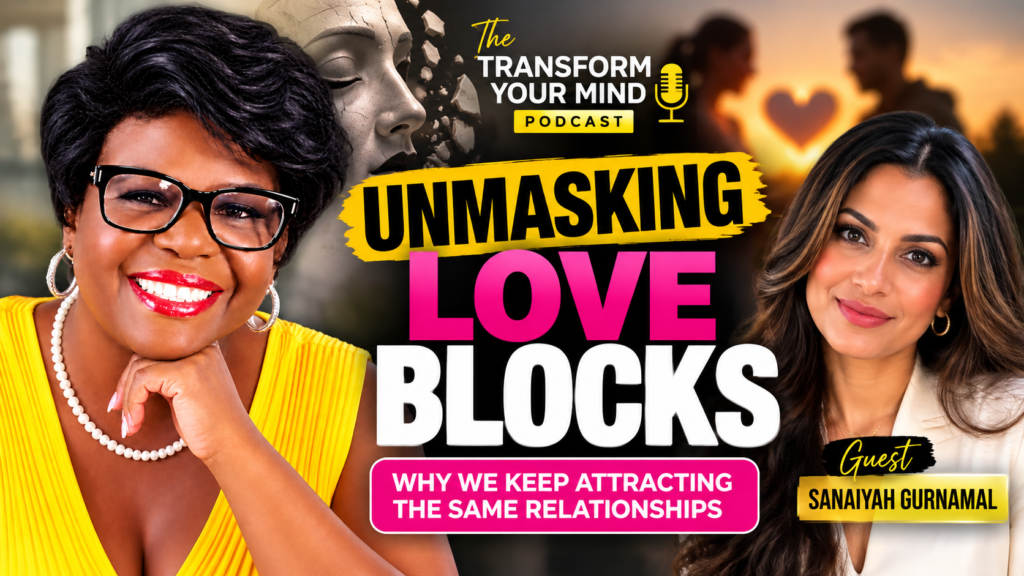
Love blocks are subconscious patterns, emotional defenses, or limiting beliefs that keep you from giving, receiving, or keeping healthy romantic love. They often act as invisible self-protection mechanisms built from past pain, fear, or early life conditioning.
Myrna Young, host of the “Transform Your Mind, Transform Your Life“ podcast, welcomes relationship reinvention coach Sanaiyah Gurnamal to discuss why people attract similar relationships. They explore subconscious patterns, childhood influences, and five love blocks, such as commitment phobia and people-pleasing.
Discover insights into how childhood experiences shape adult relationships and how individuals can break free from repetitive patterns to cultivate healthier connections. This episode dissects the intricate web of subconscious beliefs and their powerful influence on love and relationship choices.
“Want something different? We’re so focused on what we don’t want. And yet that’s what we’re repeating in our mind the whole time,” Sanaiyah explains.
Myrna, sharing personal insights, adds another layer: fear-based attraction. It seems when we have a strong aversion to a particular relationship dynamic, we may inadvertently draw it into our lives by focusing too intensely on avoiding it. This can be a revelation for many, suggesting the need for a paradigm shift in how we view and choose love.
Key Takeaways Love Blocks
- Relationship Patterns: Childhood experiences and subconscious beliefs significantly influence the types of partners we attract, often leading us to repeat familiar but possibly detrimental relationship patterns.
- Love Blocks Explained: Sanaiyah introduces key relationship blocks like the "Commitment Phobe" and "Runaway Bride," providing insights into why these behaviors manifest and how they can be overcome.
- Self-Awareness: Acknowledging one’s own role in attracting certain types of relationships is the first step toward transformation.
- Self-Love: Developing a strong, loving relationship with oneself is crucial to transforming how we relate to others and what we accept in romantic partnerships.
- Healing Pathways: Through understanding personal love blocks, individuals can begin to make conscious choices that align with healthier relationship dynamics.
The Five "Love Blocks" That Perturb Our Relationships
Gleaning from over 20 years of experience and deep conversations with thousands, Sanaiyah identifies five prominent “Love Blocks” that commonly ensnare individuals in their search for love:
#1. The Commitment Phobe:
Often attracting emotionally unavailable partners, these individuals may find themselves drawn to the thrill rather than stability, repeating patterns where every relationship is a roller coaster. Sanaiyah candidly shares her past of dating “men with baggage,” elucidating that, “I kept thinking that they were the problem… But it was me.”
#2. The Runaway Bride:
This personality type is haunted by the fear of deep commitment due to past hurts. Such individuals often come tantalizingly close to deep relationships but bolt at the last moment. This reflects an underlying fear of vulnerability and an insidious pattern of self-sabotage.
#3. The People Pleaser: Born out of a constant need for external validation often instilled during childhood, these individuals lose themselves in relationships, prioritizing their partner’s needs to the point of self-abandonment. “You could have someone who’s very helpful, who really likes to do things for other people, prioritizes other people without neglecting themselves,” Sanaiyah explains, distinguishing genuine kindness from detrimental people-pleasing.
Beyond these, two additional blocks, the Caretaker and the Memory Chaser, each present their unique patterns, where one’s solution-focused care or fixation on past idealized relationships respectively traps them in cycles.
Transform Your Relationship Patterns Through Awareness and Self-Reflection
Breaking free from these entrenched relationship patterns requires acute awareness and deliberate action. Sanaiyah offers a tangible starting point with her “Love Blocks” quiz, designed to help individuals diagnose their dominant relationship blocks. By becoming conscious of these subconscious scripts, people can make strides toward rewriting their relationship narratives.
The importance of such introspection is echoed by Myrna’s own breakthroughs during the conversation. Recognizing the significance of realizing and acknowledging subconscious fears and patterns can illuminate paths to healthier choices and self-love. This self-awareness fosters change, as it equips individuals with the knowledge needed to transform their emotions and behaviors.
Potential realignment of one’s relationship dynamics radiates outwards, impacting self-esteem, mental health, and even professional and personal growth. With trust issues being a common thread, Myrna’s reflections on her newfound understanding of these patterns exemplifies this journey: “Maybe she poured it in,” she mused regarding her family’s past, acknowledging the deep-seated trust issues affecting her own relationships.
Understanding the intimacy of relationships goes beyond the surface of romance and into the depths of our subconscious, molded by early experiences. By identifying and understanding our “Love Blocks,” individuals can break free from repetitive cycles, crafting a more fulfilling relationship narrative. As Sanaiyah and Myrna effectively discuss, the journey of self-discovery illuminates the pathways to healthier choices, promising an empowering reinvention of love in our lives.
Common Types of Love Blocks
- Feeling Unlovable: Believing deep down that you are inherently flawed, undeserving, or too much for someone to care about.
- Fear of Vulnerability: Guarding your emotions and keeping partners at arm's length to avoid rejection or betrayal.
- Repeating Toxic Patterns: Consistently choosing or attracting emotionally unavailable, critical, or destructive partners.
- Negative Inner Dialogue: Constantly telling yourself that love is impossible or that you always get hurt.
- Hyper-Independence: Believing that needing or relying on someone else is a sign of weakness.
Origins of Love Blocks
- Childhood Dynamics: Growing up with unpredictable, critical, or emotionally absent caregivers.
- Past Relationship Trauma: Experiencing severe heartbreak, infidelity, or manipulation that rewires your brain to expect danger.
- Cultural or Social Conditioning: Internalizing rigid ideas about how relationships, gender roles, or romance are "supposed" to work.
How to Unmask and Clear Repeated Patterns
#1. Identify the Trigger
Notice when you feel the urge to run away, pick a fight, or shut down during a moment of genuine closeness.
#2. Challenge the Narrative
Write down the harsh things you tell yourself about love and replace them with realistic, compassionate affirmations.
#3. Practice Receptivity
Start small by letting people do nice things for you without immediately feeling like you owe them or waiting for the other shoe to drop.
Working through deep-seated attachment wounds often goes faster with a trusted therapist or counselor.
Notable Quotes:
"We repeat patterns because our brain likes what's familiar; it seeks the comfort of what it recognizes."
"Have you ever ended a relationship and promised yourself you wouldn't date someone like that again, but found yourself in the same emotional pattern?"
"To break free from toxic patterns, we must heal the part of ourselves that associates love with past struggles and pain."
"The most important relationship is the one with yourself. Prioritizing that changes everything."
"People behave the way you invite them to, based on how you show up in the relationship."
Resources:
- Sanaiyah Gornamal's Website: Sanaiyah Gurnamal
- Sanaiyah Gornamal on Instagram: @SanaiyahGurnamal