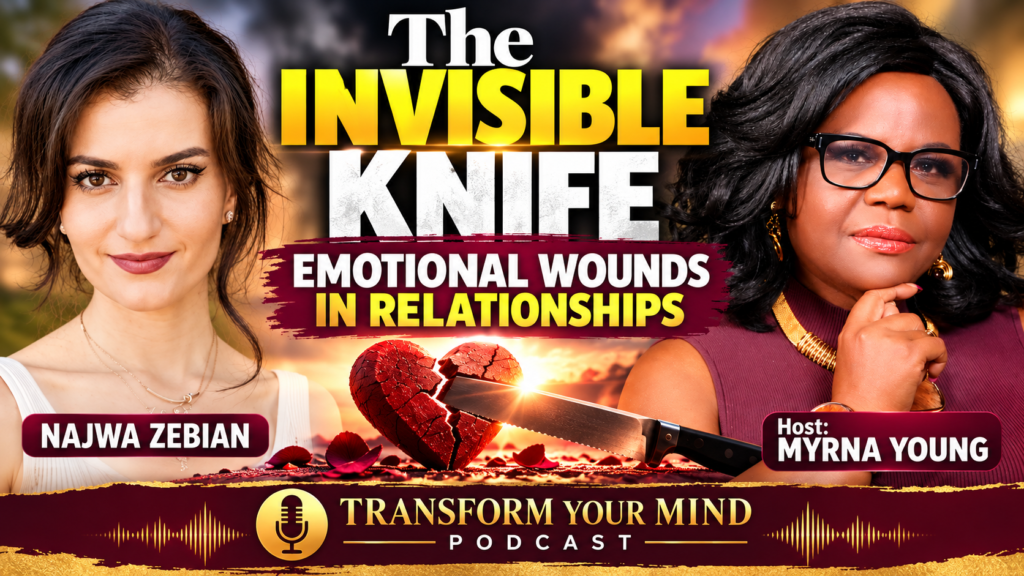
Myrna Young and Dr. Najwa Zebian delve into the psychology of toxic relationships, emphasizing emotional wounds in relationships and why the person who broke you can’t heal you. Using relatable analogies and personal stories, they explore the importance of self-healing, understanding pain, and identifying self-abandonment.
Dr. Zebian provides practical steps for reclaiming one’s life and explains the role of emotional healing. They also touch on the broader scope of toxic relationships, including friendships. Tune in for insights on moving past hurt and embracing personal growth.
Key Takeaways
- Self-validation Over External Apologies: Healing comes not from external validation but through acknowledging one's own pain and journey.
- Relationships and Self-Abandonment: Many people cling to toxic relationships due to fear and misplaced hope, often leading to self-abandonment.
- Feeling to Heal: Experiencing and acknowledging emotions like anger and pain are crucial for personal growth and recovery.
In a world where relationships define so much of our personal identity, understanding how to navigate the complex emotional terrains is crucial. The intricate dance between hurt, healing, and happiness is explored here with the insightful perspectives of Myrna Young and Dr. Najwa Zibian. They delve deep into the factors keeping individuals chained to unhealthy relationships and the empowering path of reclaiming one’s peace.
The Invisible Knife: How Emotional Wounds in Relationships Cut Deep
Not all wounds leave bruises. Some of the deepest injuries in a relationship are invisible-the cutting remark that stays with you for years, the affection that is suddenly withdrawn, the betrayal that changes how you trust, or the repeated feeling that your emotions simply don’t matter.
These are emotional wounds in relationships, and although no one else can see them, they can shape the way we love, communicate, and connect.
Think of an emotional wound as an invisible knife. A partner may say or do something that cuts deeply, yet because there is no physical injury, the pain can easily be dismissed. You may even tell yourself, “I should be over this by now.” But emotional pain doesn’t disappear simply because it cannot be seen.
Past wounds can also enter new relationships with us. Rejection may make us hyperaware of signs that someone is pulling away. Betrayal can make trust difficult. Abandonment can create fear when a partner needs space. Experiences from childhood can influence what we tolerate, what triggers us, and even what we believe love is supposed to feel like.
That is why healing requires more than identifying what someone else did to hurt us. It also requires the courage to ask: What wound did this experience touch inside me?
In my conversation with poet, author, and speaker Najwa Zebian, we explore these invisible wounds and how they affect our relationships with others-and ultimately, our relationship with ourselves.
Recognizing the wound is not about living in the past. It is about understanding the past well enough that it no longer gets to quietly control the present.
Healing begins when the invisible becomes visible.
The Power of Self-Validation Over Apologies
Expecting validation from those who hurt us is a common pitfall. People inherently yearn for external validation, especially from those who’ve wronged them. This stems from a basic human need to be seen and heard in our pain. As Najwa shares, “Ultimately, what’s really going to heal you is you deciding to feel the pain of what they did to you.”
This desire for apology and recognition from the offender is often an unsuccessful quest. An apology, while it can offer some clarity or closure, doesn’t remove the pain. Najwa illustrates this clearly with the analogy of a backstab: “Imagine if they were to tell you, ‘I did it because I wasn’t feeling a connection.’…you still have a knife in your back. You still have to get yourself to the nearest hospital.”
Healing starts from within and requires self-validation. Recognizing our own pain allows us to take the first step toward real healing, showing that only by confronting our feelings can we truly begin to heal. This prompts us to ask ourselves, how might focusing on self-validation change our journey towards healing?
Navigating the Maze of Emotional Wounds in Relationships and Self-Abandonment
Many find themselves trapped in toxic relationships, not by choice but by fear of the unknown. People tend to focus on the potential of what a relationship could be, rather than acknowledging its current state. As Myrna insightfully remarks, “A lot of women are not financially secure enough to just walk through the door when they feel like it.” This compounds fears with practical concerns.
Najwa explains that a gradual erosion of self-esteem within toxic relationships leads people to accept less than they deserve. “Bit by bit, your self-esteem is eroded,” she says, underscoring an individual’s eventual inability to see life beyond their current unhappiness. The hope that the situation might change often outweighs reality until the painful realization surfaces that the situation remains static or worsens.
Breaking free involves asking pointed questions like Najwa suggests: “What price am I willing to pay to stay in this relationship?” and creating a vision of what personal peace looks like. This is essential for building the courage to embrace solitude over toxicity-a daunting but often necessary step toward self-recovery. People must consider, how can redefining personal peace reshape their relationship decisions?
Embracing Pain as a Gateway to Personal Growth
Experiencing emotions, especially those associated with pain, is often daunting yet essential for healing. Cultural norms tend to label emotions like anger as negative or destructive. However, these emotions are natural responses to injustice and betrayal. As Najwa emphasizes, “When you give yourself permission to feel the pain…you are seeing your own pain.”
Feeling emotions authentically is a transformative act. It helps lift the emotional weight we’ve been carrying and invites personal growth. Like Dr. Gabor Maté’s work referenced by Najwa, ignoring these emotions can have severe repercussions, potentially manifesting physically or psychologically. The ability to process and express emotions fosters resilience and self-awareness.
Feelings of anger, hurt, or betrayal should not be feared but embraced as part of the human experience. The process involves acknowledging these feelings openly, thus beginning the journey of healing and empowering oneself to move forward. Reflect on this: How could transforming our fears of feeling into acceptance and understanding change our healing journeys?
How Emotional Wounds in Relationships Show Up
Emotional wounds in relationships do not always announce themselves as pain. Sometimes they show up as behaviors we mistake for personality, independence, jealousy, anger, or simply “the way I am.”
When we have been hurt before, the mind learns to protect us. The problem is that those protective responses can follow us into relationships where the original danger no longer exists.
Emotional wounds in relationships can show up as:
- Fear of abandonment: Becoming anxious when your partner seems distant, needs space, or takes longer than usual to respond.
- Difficulty trusting: Questioning someone’s intentions even when they have given you little reason to doubt them.
- People-pleasing: Suppressing your own needs because you fear conflict, rejection, or losing the relationship.
- Emotional withdrawal: Shutting down during difficult conversations because vulnerability feels unsafe.
- Overreacting to criticism: Hearing a simple disagreement as rejection or proof that you are not good enough.
- Jealousy or the need for reassurance: Constantly looking for confirmation that you are loved, wanted, or secure.
- Avoiding intimacy: Keeping an emotional distance because getting too close means giving someone the power to hurt you.
- Repeating unhealthy patterns: Being drawn to relationships that recreate familiar dynamics from childhood or previous relationships.
This is where triggers can become valuable messengers. A reaction that seems much larger than the present situation may be connected to an older wound. Your partner may have touched the bruise, but they may not have created it.
Instead of asking only, “Why did this person make me feel this way?” we can also ask, “Why did this affect me so deeply, and what is this reaction trying to show me?”
That shift creates an opportunity for healing. When we become aware of the wound beneath the reaction, we can begin responding to what is happening now instead of unconsciously reacting to what happened then.
Awareness gives us the power to interrupt the pattern-and choose a different response.
Frequently Asked Questions About Emotional Wounds in Relationships
What are emotional wounds in relationships?
Emotional wounds are unresolved feelings of hurt, rejection, betrayal, abandonment, shame, or loss that can affect how we connect with others. These wounds may originate in childhood, previous relationships, or experiences within a current relationship. Even when the original experience is over, the emotional response can continue to influence trust, communication, and intimacy.
How do you know if you have emotional wounds from a past relationship?
Some common signs include difficulty trusting, fear of abandonment, excessive need for reassurance, emotional withdrawal, people-pleasing, jealousy, or strong reactions to situations that remind you of a previous hurt. Sometimes the intensity of the reaction can be a clue that an older wound has been triggered.
Can childhood experiences affect adult relationships?
Yes. Early experiences can influence how we understand love, safety, trust, conflict, and emotional connection. Patterns learned in childhood may continue into adulthood until we become aware of them and intentionally develop healthier ways of relating to ourselves and others.
Why do emotional wounds get triggered in relationships?
Close relationships require vulnerability, which can bring unresolved fears and painful memories to the surface. A partner’s words or behavior may remind us of an earlier experience of rejection, betrayal, criticism, or abandonment-even when the present situation is different.
How can you heal emotional wounds in relationships?
Healing often begins with recognizing the wound and understanding the experiences behind it. Self-awareness, healthy boundaries, honest communication, self-compassion, supportive relationships, and, when needed, professional therapy can all be part of the healing process. The goal isn’t to erase the past but to prevent it from controlling how you respond in the present.
Can you have a healthy relationship while healing emotional wounds?
Yes. Healing does not require becoming perfectly healed before you can experience love. What matters is developing awareness of your patterns, communicating openly, taking responsibility for your reactions, and learning healthier ways to respond when old wounds are triggered.