What happens when life places you in a battle you never expected to fight? You learn about adversity and resilience especially when the people you love most are at the center of that battle. How do you find the strength to keep going?
Understanding how adversity builds resilience begins with recognizing that strength is not something we are necessarily born with. It is something we can develop through adversity and resilience, disappointments, losses, and unexpected circumstances of our lives.
We often think resilience means being strong enough to withstand anything. But sometimes true resilience is about vulnerability, surrendering to what we cannot change, learning from adversity, and discovering a strength we didn’t know we possessed.
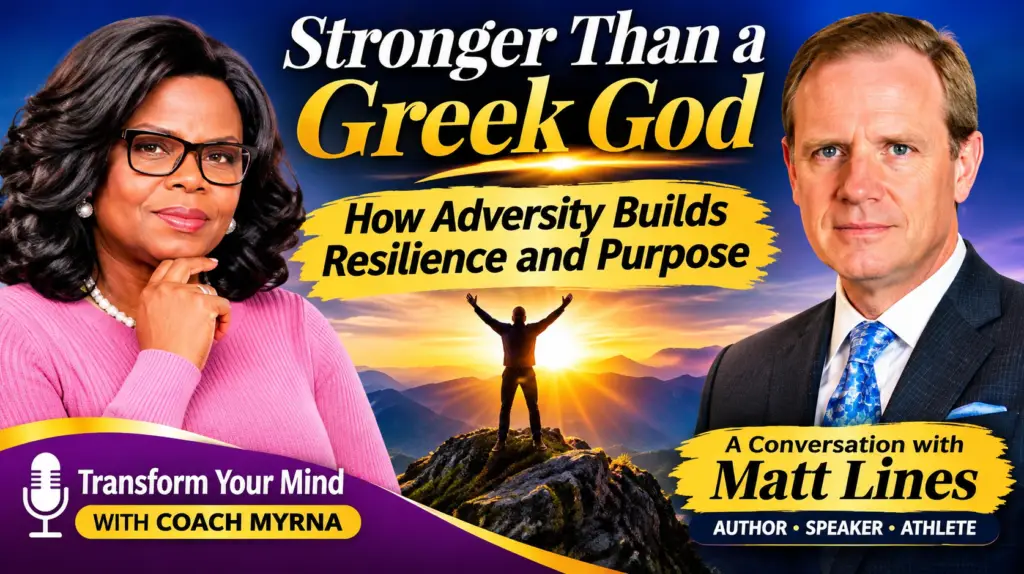
On this episode of the *Transform Your Mind* podcast, I interview Matt Lines, attorney, author, and lifelong learner, whose book, *Stronger Than a Greek God*, shares his deeply personal journey through adversity and his quest to protect his three daughters.
Through his experiences, Matt explores the intersection of adversity and resilience, Stoic philosophy, personal responsibility, meditation, and what it truly means to live well.
His story reminds us that our greatest challenges can become the training ground for our greatest transformation.
How Adversity Builds Resilience: The Story Behind the Struggle
Matt Lines never intended to become an author. He was a successful attorney practicing commercial litigation in Miami, Florida, working long hours to provide a comfortable life for his wife and three daughters.
From the outside, he appeared to have everything: a successful career, a beautiful home, a family, and substantial retirement savings.
But beneath the surface, something was happening that would eventually change the trajectory of his life.
Matt recalls a Saturday afternoon shortly before Thanksgiving in 2017 when he witnessed an incident involving his then-wife and his middle daughter that he describes as his awakening.
For years, Matt had attributed differences in their parenting styles to cultural differences. His wife had grown up in Romania, and he believed her stricter approach to parenting reflected her upbringing.
However, witnessing what he describes as physical aggression toward his daughter forced him to confront a reality he had previously struggled to acknowledge.
He intervened to protect his child, and what followed was the beginning of a painful and financially devastating divorce.
Suddenly, the life he had spent years building was falling apart.
Matt found himself fighting to protect his daughters while navigating legal proceedings, financial losses, emotional distress, and the responsibilities of his demanding career.
He eventually depleted much of his retirement savings and faced the loss of the financial security he had worked so hard to create.
Yet through this experience, Matt discovered something more valuable than money: the ability to transform himself.
Sponsor of this Podcast
Ever leave the doctor’s office with more questions than answers? Sometimes part of the answer is in your DNA, and Sequencing.com makes it easy to look.
Sequencing.com reads 100% of your DNA, not the small slice an ancestry test reads, and checks it for genetic factors linked to over 15,000 diseases, including things like inherited forms of breast cancer and high cholesterol
The process is really simple. You order a kit, swab your cheek and mail it back. That’s it! No appointments, no lab visits. Their U.S. lab handles the rest,
Right now, Sequencing.com is offering our listeners 10% off your full Genome test, plus free shipping. ● Go to Sequencing Dot com and use promo code MYRNA10 for 10% off.
- That’s Sequencing.com, promo code MYRNA10.

Recognizing the Effects of Unresolved Childhood Trauma
During our conversation, we explored how unresolved childhood trauma can affect adult relationships and family dynamics.
Matt reflected on the difficult childhood his former wife had experienced and how her past might have influenced her behavior. Although he acknowledged that he was not qualified to diagnose her, he recognized patterns that had caused him considerable distress.
One of the things I appreciated about Matt was that he did not tell his story as a campaign against his former wife. He expressed sadness and compassion while acknowledging the necessity of protecting his children.
As a trauma recovery coach, I believe understanding someone’s trauma can help us make sense of certain behaviors, but it does not mean we must accept harmful behavior.
Compassion and boundaries can coexist.
We can understand that someone has experienced pain while recognizing that we cannot allow their unresolved pain to become our children’s trauma.
Sometimes finding strength in adversity requires us to stop explaining away what is happening and start taking action to protect ourselves and those we love.
Finding Strength in adversity and resilience: Life Is Your Training Ground
When I asked Matt what his experience taught him about the true meaning of strength, his answer was profound.
“I’m not into strength as much as I am to getting stronger.”
Think about that distinction.
Strength is not necessarily a destination. Getting stronger is a continuous process.
Matt compared life’s challenges to lifting weights in a gym. When you lift weights, your muscles encounter resistance and adapt to the demands placed upon them.
Without resistance there is little incentive for those muscles to grow.
Matt believes that life’s circumstances can serve as training weights for our emotional and mental development.
The unexpected divorce, the financial setback, the betrayal, the disappointment, or the career crisis can become opportunities to develop qualities we might never have discovered otherwise.
This does not mean that suffering is necessary for growth or that adversity automatically makes everyone stronger. Sometimes adversity overwhelms us, and we need professional support, rest, and time to recover.
But when we have the resources and support to work through our challenges, we can begin to discover how adversity builds resilience.
Instead of asking only, “Why is this happening to me?” we can eventually begin asking, “What can I learn from this experience?”
That shift opens the door to personal transformation.
Moving Beyond the Victim Mindset
Matt explained that one of the greatest challenges during his divorce was recognizing when his thoughts were moving toward helplessness.
When one difficult event follows another, it is easy to begin believing that life is happening to us and that we have no influence over what comes next.
Matt credits his therapist with helping him recognize these patterns and develop a healthier way of thinking.
There is an important distinction between being victimized and allowing helplessness to become the defining feature of your identity.
If someone has harmed you, acknowledging that harm is part of healing. You do not need to deny your experience or accept responsibility for someone else’s actions.
However, as you recover, you can gradually reclaim your ability to make decisions about your future.
You may not have chosen what happened to you, but with support, you can begin to influence who you become afterward.
That is one of the foundations of building emotional resilience.
How Reframing Negative Thoughts Builds Emotional Resilience
One of my favorite moments in this interview came when Matt described losing his retirement savings.
As a young attorney, he had been financially disciplined. Rather than spending all his money, he invested in retirement accounts, accumulating hundreds of thousands of dollars.
Those savings could have allowed him to retire early.
Instead, he found himself using that money to pay legal expenses during his divorce and custody battle.
He could have focused exclusively on everything he had lost. He could have spent years regretting the disappearance of his financial security.
But Matt chose a different perspective.
He recognized that the money he had saved was available when he needed it most. It gave him the resources to fight for his daughters.
Rather than seeing his savings as money wasted, he began seeing them as resources that had served an important purpose.
When he shared this perspective, I immediately recognized the coaching technique he was using: reframing.
What Is Reframing?
Reframing is the process of examining an experience from a different perspective.
It does not change what happened. It changes how we interpret what happened and what meaning we assign to it.
For example:
– Instead of saying, “I wasted years of my life,” consider, “Those years taught me what I need from my future.”
– Instead of saying, “I failed again,” consider, “I have more information about what does not work.”
– Instead of saying, “I lost everything,” consider, “What remains, and what can I build from here?”
– Instead of saying, “My past determines my future,” consider, “My past can inform my future without controlling it.”
Reframing is not about pretending everything is wonderful. It is about developing a perspective that acknowledges reality without surrendering your ability to move forward.
Matt’s financial losses also helped him confront a scarcity mindset he believed he had inherited from his childhood.
He discovered that many of the things that brought him happiness did not require money.
The sunshine was free. The beauty of the sky was free. Spending meaningful time with his daughters brought him joy.
As Matt explained, one of the unexpected lessons of losing so much was that he was no longer as afraid of losing everything.
That realization later gave him the courage to pursue a new direction in his legal career.
Stoic Philosophy: Turning Adversity and Resilience Into Fuel for Personal Growth
Matt’s book, *Stronger Than a Greek God*, draws heavily on Stoic philosophy and its approach to navigating life’s difficulties.
His introduction to Stoicism began through therapy. He learned about cognitive behavioral approaches and the work of psychologist Albert Ellis, whose rational emotive behavior therapy drew inspiration from Stoic ideas.
Matt became fascinated by the possibility of developing a more sustainable philosophy for living.
One of the metaphors he shared during our conversation was the image of an inner fire.
Imagine that you have a fire burning inside you. Every challenge life throws your way can potentially become fuel for that fire.
Rather than allowing every disappointment to extinguish your spirit, you can explore whether there is something within that experience that can contribute to your growth.
The fire becomes stronger as it consumes the fuel.
This metaphor resonated deeply with me because it aligns with one of the central messages I teach as a trauma recovery coach: we can transform the garbage of our lives into compost for our personal growth.
The garbage represents the painful experiences, disappointments, betrayals, and losses we encounter.
The compost represents the wisdom, awareness, boundaries, compassion, and resilience we can develop as we process those experiences.
The flowers represent the meaningful life we can create afterward.
Create Your Own Book of Wars
During the interview, I shared a practice I call my Book of Wars.
I keep a record on my phone of the battles I have fought and the victories I have experienced.
Why is this important?
Because when another challenge arrives, we sometimes forget everything we have already overcome.
We become so consumed by our present circumstances that we lose sight of the evidence of our own resilience.
When life knocks me down unexpectedly, and I experience adversity and resilience. I revisit my Book of Wars and remind myself that I have faced difficult circumstances before.
I have survived disappointment. I have overcome obstacles. I have found solutions when I initially could not see a way forward.
Your Book of Wars does not have to contain extraordinary accomplishments.
It can include the day you established a difficult boundary, left an unhealthy relationship, asked for help, recovered from a setback, or found the courage to start again.
Record your victories.
They are reminders that your current circumstances are not the full measure of your strength.
How Adversity Builds Resilience by Transforming Your Identity
One of the most interesting parts of my conversation with Matt was exploring how adversity changed his identity.
Before his divorce, Matt primarily saw himself as a provider. He worked long hours, built financial security, and focused on creating abundance for his family.
When his daughters needed protection, he stepped into a different role.
But his transformation did not end there.
Through his experiences, Matt became someone who prioritized his mental health, spiritual well-being, and the emotional well-being of his children.
His definition of success changed.
Success was no longer measured exclusively by professional accomplishments, financial security, or the size of his home.
It became increasingly connected to peace, meaningful relationships, personal freedom, and his ability to enjoy everyday life.
Sometimes adversity builds resilience by forcing us to examine an identity that no longer serves us.
Perhaps you have spent your entire life identifying as the person who takes care of everyone else.
Perhaps your identity is connected to your marriage, your career, your financial status, or the approval of others.
What happens when those things change?
Who are you when the roles you have played for years no longer define your life?
Learning to Surrender Without Giving Up
Matt shared a Stoic metaphor about a dog tied to a moving cart.
The dog can resist the movement of the cart, exhausting itself in the process, or it can learn to move with it.
The lesson is not that we should surrender to every circumstance. Matt himself fought tirelessly to protect his daughters.
Rather, the lesson is about discernment.
We must learn to distinguish between circumstances we can influence and realities we must eventually accept.
Acceptance is not approval. It is recognizing what is real so that we can direct our energy toward what remains possible.
Sometimes holding on to an old version of ourselves becomes more painful than allowing ourselves to change.
And sometimes the way out of our suffering begins with accepting that we cannot return to the life we once knew.
The Stronger Than a Greek God System: Three Pillars of Resilience
Through his personal struggles, Matt developed a system that helped him manage his emotional distress and transform his habits.
His system consists of three pillars:
1. Intermittent fasting.
2. Meditation.
3. Stoic philosophy and cognitive behavioral techniques.
These practices emerged organically as Matt searched for ways to cope with his circumstances.
Pillar One: Intermittent Fasting and Intentional Living
During the early stages of his emotional crisis, Matt experienced a significant loss of appetite and unintended weight loss.
Later, he became interested in intermittent fasting and experimented with eating one meal a day, commonly known as OMAD.
Matt reported that this approach simplified his daily routine, reduced the time he spent preparing meals, and helped him feel more focused.
For someone balancing a demanding legal career, parenting responsibilities, and ongoing litigation, reclaiming time was particularly valuable.
However, intermittent fasting is not appropriate for everyone, and eating only one meal a day is a restrictive approach that can make meeting nutritional needs difficult.
Matt’s experience represents his personal journey rather than a universal recommendation. Anyone considering significant dietary changes should consult a qualified healthcare professional, particularly if they have underlying health conditions or take medications.
The broader lesson is that intentional daily habits can create structure during periods when life feels chaotic.
Pillar Two: Meditation for Building Emotional Resilience
Matt began meditating for just five minutes during his lunch break.
He would go outside, sit on a park bench, set a timer, close his eyes, and focus on his breathing.
Like many beginning meditators, he quickly discovered that his mind wandered.
Thoughts about work, responsibilities, and unfinished tasks would interrupt his concentration.
Whenever he noticed his attention drifting, he gently returned his focus to his breath.
Over time, this practice helped him recognize something important: many of the fears he experienced began with thoughts.
He learned that he did not have to automatically follow every fearful thought wherever it led.
He could notice the thought and redirect his attention.
This is one of the reasons meditation can be a valuable practice for building emotional resilience.
Meditation creates an opportunity to become more aware of what is happening in your mind before reacting automatically.
As someone who practices meditation regularly, I use it to relax, reconnect with my spiritual self, and become more intentional about where I direct my attention.
You do not need to meditate for an hour to begin.
Start with five minutes.
Notice your breathing. Notice when your mind wanders. Return your attention to the present moment.
The practice is not about eliminating thoughts. It is about developing awareness of them.
Pillar Three: Rewiring Your Mind Through Cognitive Reframing
The third pillar of Matt’s system involves examining and challenging unhelpful thoughts.
Through therapy and Stoic philosophy, Matt learned to question the assumptions that contributed to his emotional distress.
For example, someone struggling with personal transformation might think:
“I have failed before, so I will probably fail again.”
But does past failure guarantee future failure?
Of course not.
Your previous experiences may offer useful information, but they are not predictions of everything that will happen in your future.
By challenging that thought, you create space for a more constructive perspective:
“I have struggled before, but I can learn from those experiences and try a different approach.”
This is where meditation and cognitive reframing can complement each other.
Meditation helps you notice the thought. Reframing helps you examine and respond to it.
Over time, practicing healthier responses can help you develop more constructive patterns of thinking.
Your Mind Is a Garden: Remove the Weeds of Negative Thinking
During our conversation, Matt used another metaphor that I absolutely loved.
Your mind is like a garden.
If you neglect a garden, weeds can grow and compete with the plants you intentionally planted.
Your mind can operate in a similar way.
Automatic negative thoughts can appear repeatedly until they begin to influence how you see yourself and what you believe is possible.
I call these thoughts ANTs: automatic negative thoughts.
They sound like:
– I am not good enough.
– Nothing ever works out for me.
– I will never find love.
– I cannot accomplish my goals.
– I am too old to start again.
– My past has ruined my future.
The challenge is that many of these thoughts become so familiar that we stop questioning them.
We begin treating them as facts.
But a thought is not necessarily the truth.
Just because you have repeated a belief for years does not mean you must continue believing it.
Meditation can help you catch these thoughts, and cognitive reframing can help you examine them.
Ask yourself whether the thought is accurate, whether it is useful, and whether another perspective is possible.
You cannot always control which thoughts appear in your mind, but you can practice becoming more intentional about which ones you nurture.
Remember, the thoughts you repeatedly cultivate can influence the direction of your life.
Transforming Adversity and Resilience into Purpose: The Gift of Personal Transformation
One of the most meaningful outcomes of Matt’s adversity and resilience was his decision to share what he had learned with others.
His book began as notes on his phone. He was trying to make sense of his circumstances, organize his thoughts, and maintain clarity during a difficult period.
Eventually, those notes became the foundation of *Stronger Than a Greek God*.
The experiences that once caused him tremendous pain became the material through which he could encourage others.
That is what transforming pain into purpose can look like.
Your purpose does not necessarily have to involve writing a book, becoming a coach, or speaking on a stage.
It might involve becoming a more compassionate parent, supporting someone who is experiencing a similar struggle, establishing healthier relationships, or breaking a destructive generational pattern.
You also do not owe anyone a public account of your trauma. Healing can be private and still be deeply meaningful.
What matters is recognizing that your painful experiences do not have to be the final chapter of your story.
You can create something meaningful from the lessons you have learned.
Five Practical Ways to Build Resilience Through Adversity
If you are currently navigating a difficult chapter, here are five lessons from my conversation with Matt Lines that you can begin applying to your own life.
### 1. Focus on What You Can Influence
You cannot control every circumstance, but you can identify the decisions, boundaries, and actions that remain within your influence.
### 2. Practice Reframing Your Experiences
When you are ready, explore whether a painful experience contains a lesson or a perspective that could help you move forward.
### 3. Develop a Daily Meditation Practice
Start with five minutes of intentional breathing and awareness. Practice noticing your thoughts without immediately reacting to them.
### 4. Record Your Victories
Create your own Book of Wars. Document the challenges you have overcome so that you can remember your capacity for resilience when new challenges arise.
### 5. Seek Support and Redefine Success
Give yourself permission to ask for help. Consider whether your current definition of success reflects what genuinely matters to you.
Sometimes the greatest victory is not getting everything back that you lost. It is becoming someone who can create a meaningful life beyond that loss.
Conclusion: You Are Stronger Than Your Circumstances
My conversation with Matt Lines reminded me that we do not always get to choose what happens to us, but we can learn to influence who we become afterward.
Understanding how adversity builds resilience is not about celebrating suffering. It is about recognizing the possibility of transformation beyond suffering.
Matt’s journey from successful attorney to protective father, author, and advocate for personal transformation demonstrates how our priorities, identities, and perspectives can evolve through life’s most difficult chapters.
Your difficult chapter does not have to become your entire story.
The pain you experienced may have changed you, but it does not have to define your future.
As I often say, we have the power to transform the garbage of our lives into flowers. We can process what was painful, learn from it, and use those lessons to create something meaningful.
You may not see the way forward today. But that does not mean there is no way forward.
Keep growing. Keep healing. Keep transforming.
About Matt Lines
Matt Lines is a Miami-based attorney, author, and lifelong student of personal development and Stoic philosophy.
His book, *Stronger Than a Greek God*, chronicles his personal journey through adversity and introduces the transformational system he developed through meditation, fasting, and cognitive reframing.
Matt also shares inspirational messages through his YouTube channel, *Thoughts from the Truck*.
His book is available on Amazon.
**Listen to the full interview on the Transform Your Mind podcast.**
Transform Your Mind Podcast Personal Development Podcast
If this conversation inspired you, share it with someone who needs a reminder that their current circumstances do not have to determine their future.
Until next time, Transformers, remember to transform your mind so you can transform your life.
If you would like to be a guest on the podcast, submit your application Here:
Transform Your Mind Guests | Transform Your Mind Podcast
Enjoyed this conversation? Please Leave a written review on Apple Podcast, it helps us transform the lives of more people.
https://podcasts.apple.com/us/podcast/transform-your-mind/id1144973094
Additional Resources
Matt Lyons’ Book: “Stronger Than a Greek God” available on Amazon.
Website: mattlines.com
To uncover the full depth of Matt Lyons’ journey and his insights on overcoming adversity, tune in to the complete episode.