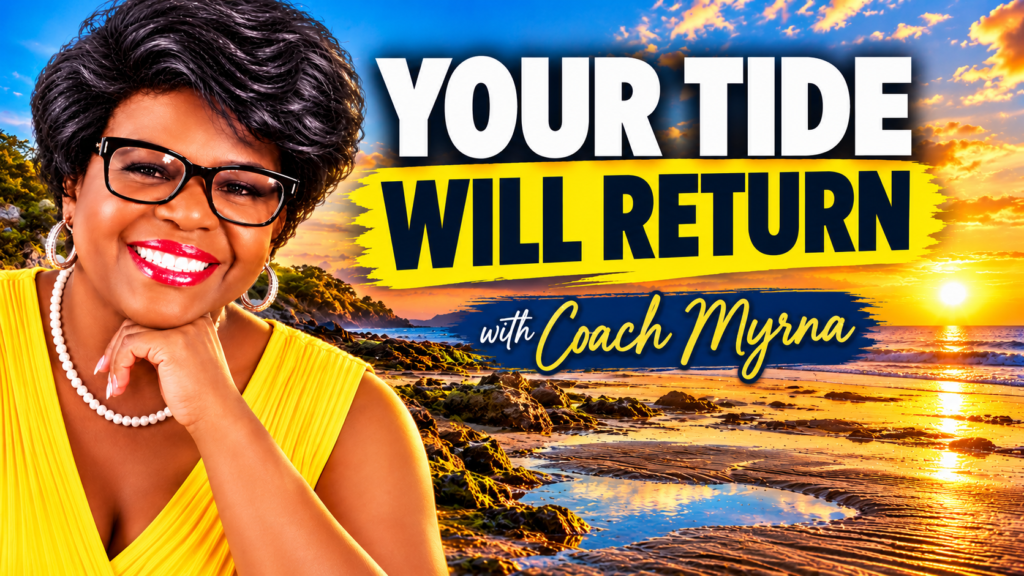
Have you ever felt like everything in your life was going backward? We can learn life lessons from the ocean. What if your finances are struggling, a relationship has ended, or an opportunity you counted on has disappeared?
What if your current setback isn’t the end of your story, but simply a low-tide season? Your tide has gone out!
In this inspiring solo episode of Transform Your Mind podcast, life coach Myrna Young shares powerful life lessons from the ocean inspired by her walks along Florida’s beaches and a recent Alaskan cruise: The first lesson!
The ocean never worries when the tide goes out because low tide is part of a natural cycle.
Just as the gravitational forces of the moon and sun influence the ocean’s tides, we experience seasons of abundance, uncertainty, loss, and renewal.
Through personal reflections, spiritual wisdom, and practical mindset strategies, Myrna explores how to stop creating additional suffering through fear and negative self-talk. Discover the hidden life lessons from the ocean that can help us navigate difficult seasons and respond to uncertainty with greater confidence.
In This Episode, You’ll Discover
- Why life like the ocean has seasons of ebb and flow: Understanding the ocean’s natural rhythms and what they teach us about accepting change.
- What your low-tide season reveals: How financial struggles, relationship challenges, and rejection can expose limiting beliefs, emotional wounds, and opportunities for growth.
- How fear creates secondary suffering: Why the stories we tell ourselves about setbacks can be more emotionally exhausting than the setbacks themselves.
- How to manage financial uncertainty: Why trusting the process still requires budgeting, working, saving, and making responsible decisions.
- The power of faith and emotional resilience: How to move forward without allowing temporary circumstances to define your future.
The Science Behind Life Lessons from the Ocean
Ocean tides are primarily influenced by the gravitational pull of the moon, with the sun also contributing to changes in tidal range.
During new and full moons, the sun and moon’s gravitational effects reinforce one another, producing spring tides. During the quarter-moon phases, their effects partially offset each other, creating neap tides.
The ocean’s water hasn’t disappeared when the tide recedes. It’s simply responding to forces that aren’t immediately visible.
Myrna uses this natural phenomenon to illustrate a powerful mindset lesson:
What you see happening in your life right now isn’t necessarily the whole story.
Key Facts About Lunar Gravity
- Surface Weight: Objects and people on the Moon weigh only about 16.6% of what they weigh on Earth (for example, a 180-pound person weighs roughly 30 pounds on the Moon).
- Ocean Tides: The Moon’s gravitational pull is the primary driver of Earth’s ocean tides, creating tidal bulges on both the side facing the Moon and the opposite side.
- Earth Stabilization: The gravitational interaction between Earth and the Moon helps stabilize Earth’s axial tilt, which supports a relatively steady climate.
- Tidal Locking: Earth’s gravity has tidally locked the Moon, meaning the Moon rotates on its axis at the same rate it revolves around Earth, so the same side always faces our planet
5 Powerful Life Lessons from the Ocean: When Life Gets Hard
What Is Your Low-Tide Season Teaching You?
Financial difficulties may reveal fears about scarcity or your ability to manage uncertainty.
Relationship challenges may uncover abandonment wounds or an unhealthy dependence on external validation.
Rejection may reveal how much of your self-worth depends on other people’s approval.
Rather than asking, “Why is this happening to me?” try asking:
“What is this season revealing to me, and what can I learn from it?”
That shift in perspective can help you respond more constructively.
Stop Fighting Your Low Tide Season
When life doesn’t go according to plan, it’s easy to create additional suffering through thoughts such as:
- Nothing ever works out for me.
- I’m always going backward.
- I’ll never recover from this setback.
- I’m running out of time.
But worrying about the tide won’t make the water return any faster.
Instead of exhausting yourself through fear, comparison, resentment, or regret, focus on what you can control.
Adjust your spending. Seek support when needed. Continue developing your skills. Address emotional wounds. Make decisions that support your future.
Trusting the process doesn’t mean doing nothing. It means taking meaningful action without allowing fear to control your life.
Life Lessons from the Ocean: Overcoming Difficult Seasons
- Ground yourself in what is true: Make a simple list of facts or core beliefs that remain stable when everything else feels chaotic.
- Simplify your goals: Drop non-essential expectations. Focus only on basic daily survival, routine self-care, and the next right step.
- Give yourself grace to feel: Acknowledge your grief, exhaustion, or frustration instead of masking them, but refuse to set up permanent camp in despair.
- Accept help from others: Let trusted friends, family, or professional counselors share your load rather than isolating yourself.
- Look for small sources of hope: Notice daily, ordinary blessings—like a morning walk, a kind word, or a quiet moment—to keep your perspective anchored
Final Thoughts
There will be seasons when your finances feel uncertain, relationships change, opportunities disappear, and the garden you’ve planted seems bare.
But don’t confuse what you cannot see with what does not exist.
A difficult season doesn’t have to become your permanent identity.
The tide went out. The ocean didn’t disappear.
If this message encouraged you, share it with someone who may be navigating a low-tide season of their own.
And remember: Keep transforming your mind so you can transform your life.
Frequently asked questions: Life Lessons from the Ocean
1. What does it mean to trust the process during difficult times?
Trusting the process means accepting that challenges and uncertainty are part of life while continuing to take constructive action. It involves patience, resilience, and recognizing that present circumstances don’t necessarily determine your future.
2. What can ocean tides teach us about life?
Ocean tides demonstrate natural cycles of movement and change. As a metaphor, they remind us that periods of loss or uncertainty can be opportunities for reflection, adjustment, and personal growth.
3. How can I stop worrying when life feels uncertain?
Begin by separating what has actually happened from the negative predictions your mind creates. Focus on what you can control, practice mindfulness, seek appropriate support, and take one practical step forward.
4. How can financial setbacks help us grow?
Financial challenges can reveal spending habits, fears about scarcity, and opportunities to improve money management. Building financial resilience requires practical planning alongside a healthier mindset.
5. Life Lessons from the Ocean: Why do difficult seasons reveal emotional triggers?
Stressful experiences can activate underlying fears, attachment patterns, and unresolved emotional wounds. Recognizing these reactions can help you understand yourself better and seek support or counseling when needed.
Download the podcast Here
Additional Resources
Link to the Transcript