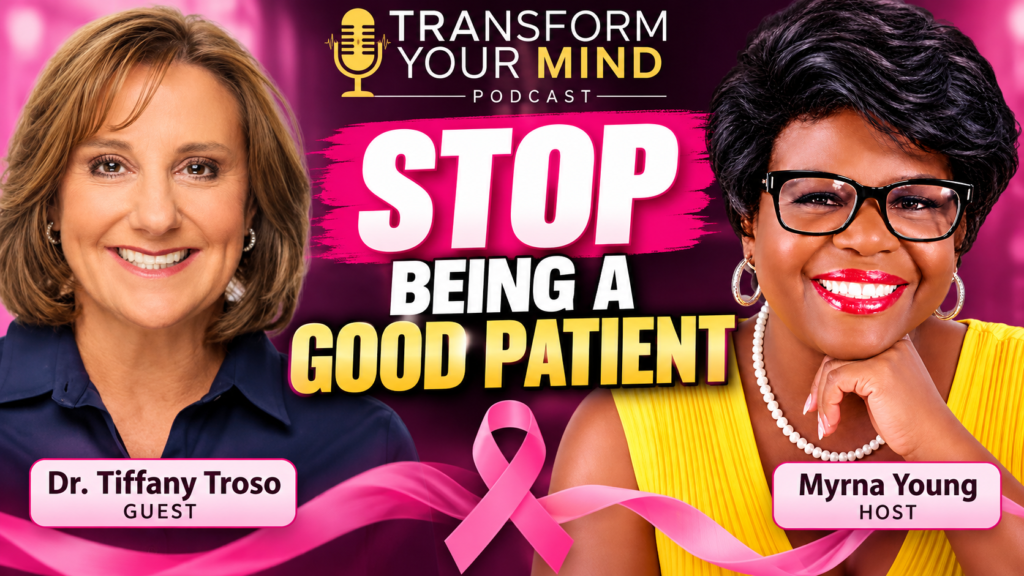
Could being a “good patient” actually put your health at risk? In this article and podcast episode we are talking about breast cancer self-advocacy.
For generations, women have been conditioned to be agreeable, trust authority, and avoid asking too many questions. But when you’re facing a breast cancer diagnosis, staying silent could mean missing important information about your breast cancer treatment options.
During Breast Cancer Awareness Month, we’re moving beyond pink ribbons and early detection to explore a potentially life-changing conversation: Why every woman must learn to self-advocate for herself in healthcare.
In this episode of Transform Your Mind, host Myrna Young sits down with Dr. Tiffany Troso, a board-certified medical oncologist, to discuss the power of breast cancer self-advocacy in cancer care. The questions every patient should ask, and how to become an informed, confident partner in your treatment decisions.
Breast Cancer Diagnosis: Breast Cancer Self-Advocacy to Empower Your Care
October heralds Breast Cancer Awareness Month, a crucial period for women worldwide to enhance their understanding of breast cancer and the critical role of self-advocacy in healthcare. Life coach Myrna Young and Dr. Tiffany Trosso, a board-certified oncologist, delve into the imperative of women owning their health narratives, particularly when confronting a breast cancer diagnosis.
This article unravels pivotal insights from their conversation and explores how women can transform their healthcare journeys.
Key Takeaways
- Women must become active participants in their healthcare embracing breast cancer self-advocacy to achieve better cancer treatment outcomes.
- Understanding the specifics of one's cancer and treatment options is crucial for informed decision-making.
- Emotional preparedness and proper organization can significantly enhance a patient's ability to manage cancer treatment effectively.
The Importance of Being Your Own Breast Cancer Self-Advocate
Women are often societal caregivers, nurturing families, and communities, but when it comes to personal health, many find it challenging to self-advocate for themselves. Dr. Tiffany Trosso emphasizes. “The most dangerous thing a woman with cancer can be is agreeable.” This assertion places the spotlight on the necessity for women to assert their needs and concerns within medical settings, particularly after a cancer diagnosis.
The cultural and psychological aspects discussed highlight how women often defer to medical authority, potentially neglecting their instincts or questions. Dr. Trosso urges women to “actively participate in their care,” insisting that passive compliance could lead to suboptimal outcomes. By preparing questions and being informed about one’s condition, women can ensure that they receive personalized care.
Understanding the scientific foundation of one’s diagnosis-such as differentiating between hormone receptor-positive and triple-negative breast cancer-is essential. As Myrna Young notes, “Understanding and planning helps bring the fear down because a lot of the fear is often the unknown.” Education and empowerment pave the way for clearer communication with healthcare providers and enhance treatment confidence.
What is Hormone Receptor-positive Breast Cancer
Hormone receptor-positive (HR-positive) breast cancer means that the cancer cells have proteins (receptors) that attach to estrogen or progesterone, using these hormones as fuel to grow and multiply.
Types of HR-Positive Breast Cancer
- Estrogen receptor-positive (ER+): Cells have receptors for estrogen; this is the most common subtype.
- Progesterone receptor-positive (PR+): Cells have receptors for progesterone.
- ER/PR-positive: Cells have receptors for both estrogen and progesterone.
How It Is Tested
- Immunohistochemistry (IHC): A lab test performed on tissue from a biopsy or surgery that uses special antibodies to detect hormone receptors.
- Positive Result: Generally defined as at least 1% of the cancer cells showing receptors. Results can also be categorized as low-positive (1% to 10%) or strongly positive (greater than 10%).
Treatment Options
Because these tumors rely on hormones to grow, they are typically treated with endocrine therapy (hormone therapy):
- Selective Estrogen Receptor Modulators (SERMs): Drugs like tamoxifen that block estrogen from attaching to the cancer cells.
- Aromatase Inhibitors (AIs): Drugs that reduce the amount of estrogen the body makes (often used in postmenopausal women).
- Selective Estrogen Receptor Degraders (SERDs): Medications that block and break down estrogen receptors.
- Targeted and Combination Therapies: Additional treatments (such as CDK4/6 inhibitors) may be paired with hormone therapy depending on the stage and features of the cancer.
Triple-negative Breast Cancer (TNBC)
Triple-negative breast cancer (TNBC) is an invasive breast cancer that tests negative for estrogen receptors (ER), progesterone receptors (PR), and HER2 protein growth signals.
- Prevalence: Accounts for about 10% to 15% of all breast cancer cases.
- Demographics: More common in younger women (under 40), Black and Hispanic women, and people with inherited BRCA1 gene mutations.
- Aggressiveness: Tends to grow, spread faster, and have a higher risk of recurrence than other types.
Common Symptoms
- A hard lump or thickening in or near the breast or underarm
- Unexplained changes in breast size, shape, or symmetry
- Skin dimpling, puckering, or an "orange peel" texture
- Nipple inversion or unusual (clear or bloody) discharge
- Redness, swelling, or scaling of the breast, nipple, or areola
Treatment Options
Because hormone and standard HER2 therapies do not work, treatment typically involves:
- Surgery: Lumpectomy or mastectomy for early-stage disease.
- Chemotherapy: Often used before surgery (neoadjuvant) to shrink tumors or after surgery to prevent recurrence.
- Immunotherapy: Combined with chemotherapy for certain cases (such as PD-L1-positive tumors).
- Targeted Therapies: Options like PARP inhibitors for BRCA mutations or antibody-drug conjugates (ADCs)
Navigating Cancer Diagnosis with Breast Cancer Self-Advocacy
Hearing the words “You have cancer” is undeniably daunting. Yet, with the right strategies, this period doesn’t have to be paralyzing. Dr. Trosso advises women to become the “CEO of their cancer care,” which involves meticulous organization to combat the chaos surrounding a cancer diagnosis.
Firstly, assembling a solid support network is paramount. Dr. Trosto advises, “Have a friend, confidant, or family member who listens well and can take notes for you.” This person can be instrumental in processing medical information during consultations when emotions may cloud comprehension.
Moreover, personal organization through a planner can significantly alleviate stress. Here, Dr. Trosso highlights the utility of maintaining a health diary to document treatment schedules, symptoms, and medication effects. Such systematic documentation not only aids in tracking one’s health journey but also facilitates clearer communication with healthcare providers, and breast cancer self-advocacy ensuring that treatments are fine-tuned to individual needs.
Emotional Resilience and the Role of Support Systems
Emotional turmoil accompanying a breast cancer diagnosis is natural, and managing it is crucial for overall health. Dr. Trosso underscores the importance of processing intense initial emotions, recommending practical steps such as “cry, scream, hit a pot…to help get out that immediate surge of anger and fear.”
Support from family and friends cannot be understated. Effective delegation concerning day-to-day responsibilities can provide relief. By clearly communicating needs-like meal support or help managing insurance paperwork-patients can foster a supportive environment, reduce stress and allow for a more focused approach to treatment.
Additionally, the discussion of treatment responses over statistical survival rates marks a shift towards hope and individualized care pathways. By aligning with one’s support system and medical team, fear can gradually transform into empowerment and proactive health management, facilitating a healthier mindset and potentially improving outcomes.
Looking Ahead: Empowerment in Cancer Care
The dialogue between Myrna Young and Dr. Tiffany Trosso reiterates a vital message: empowerment through education and breast cancer self-advocacy can significantly shape the outcome and experience of cancer treatment.
As Dr. Trosso aptly puts it, “At the end of the day, you as the patient, you’re the most important one in the room.” By understanding one’s condition, leaning on support networks, and communicating openly with healthcare providers, women can transition from passive participants to influential voices in their health journeys.
The podcast encourages women to seek out resources like Dr. Trosso’s book, “Calming the Cancer Chaos,” which provides detailed advice on regaining confidence post-diagnosis. Such resources symbolize a broader movement towards demystifying cancer treatment, advocating for individualized care, and fostering emotional resilience. Breast Cancer Awareness Month serves as a timely reminder: Your health is worth speaking up for. Empowerment begins with finding your voice.
Additional Resources
- Dr. Tiffany Trosso's website: Drtiffanytroso.com
- Podcast: "The Empowered Cancer Patient"
- Follow Dr. Tiffany Trosso on Instagram and Facebook
- The Emotional Trials and Fear of Cancer
- Podcast Transcript
Health Resources Store curated by Dr. Tiffany Trosso (available through her website)