What if some of your thoughts, emotions, and behaviors are being driven by hidden programming you don’t consciously recognize? Inner AI and mental health are deeply connected through the unconscious patterns that influence how we respond to relationships, stress, fear, and change.
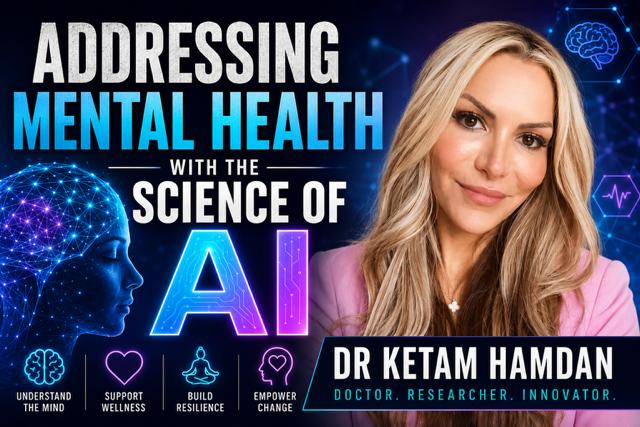
Dr. Ketan Hamdan joins host Myrna Young on the Transform Your Mind podcast to explore this concept and the difference between simply changing a behavior and creating genuine transformation. Their conversation examines self-awareness, unresolved emotions, survival patterns, and how understanding your inner world can support emotional growth.
Dr. Hamdan shares insightful strategies for cultivating presence and self-reflection. Underscoring the importance of knowing oneself to facilitate growth. Tune in to discover practical tools that can help shift from survival mode to a more fulfilling and conscious life.
Key Takeaways
- The integration of self-reflection and a willingness to explore one's inner world can catalyze genuine transformation.
- Embracing dualities in emotions and acknowledging unresolved feelings can alleviate self-sabotage.
- Grounding techniques and subtle biohacks can enhance emotional well-being and foster personal insight.
In our fast-paced world, we’re often stuck in the treadmill of daily life, rarely pausing to delve into the depths of our minds and emotions. A crucial conversation with Dr. Ketam Hamdan on the Transform Your Mind podcast sheds light on this very issue.
In our fast-paced world, we’re often stuck in the treadmill of daily life, rarely pausing to delve into the depths of our minds and emotions. A crucial conversation with Dr. Ketam Hamdan on the Transform Your Mind podcast sheds light on this very issue.
What Is Inner AI and How Does It Affect Mental Health?
“Inner AI” describes the hidden emotional programming and unconscious patterns that influence how we think, feel, react, and make decisions. Just as artificial intelligence operates through patterns and learned information, our minds develop their own internal patterns from past experiences, relationships, beliefs, and unresolved emotions.
These patterns can operate beneath our conscious awareness. A childhood experience, emotional wound, fear of rejection, or long-held belief may influence how we respond to stress, relationships, conflict, and opportunity years later. Becoming aware of this inner programming gives us an opportunity to interrupt automatic reactions and choose healthier responses.
In my conversation with Dr. Ketan Hamdan on the Transform Your Mind podcast, we explore how greater self-awareness can help people recognize these hidden patterns, move beyond survival mode, and create meaningful emotional change.
We live surrounded by algorithms. They curate our music feeds. Structure the emails we reply to, and quietly filter the information we consume. But beyond the familiar tools like Inner AI or the massive models reshaping our workflows, there is a deeper, more philosophical shift occurring. Artificial intelligence is no longer just an instrument. It is becoming a partner in how we live, work, and even understand intelligence itself.
#1. Decoding the "Black Box"
For years, the inner workings of AI neural networks were notoriously described as a “black box“. Engineers simulated pseudo-neural tissue, rewarded the systems when they produced the right results, but couldn’t look inside to see how the logic was formed.
Today, that narrative is dramatically changing. Researchers are decoding AI’s internal state using techniques like dictionary learning and sparse autoencoders. Instead of simply looking at what the machine predicts. Scientists are peering into the machine’s “soul” to find the core principles it uses to structure information.
By understanding what models “believe” at a granular level, we are taking one of the most important leaps in technological transparency in history.
#2. The Inner AI Algorithmic Architecture of Everyday Life
Spotify are fine-tuned by predictive inner Ai algorithms. The digital nudges and recommendations we interact with daily are built on behavioral design and patterns.
Being literate in the 21st century means decoding this influence. It requires understanding that every digital environment is a choice architecture designed to keep us scrolling, shopping, or engaging. Awareness of these patterns transforms silent manipulation into an opportunity for intentional living.
#3. Reflecting on Human Intelligence
Perhaps the most fascinating aspect of decoding the inner AI code is how it reflects on our own biology. Philosophers, psychologists, and AI experts are pointing out that the more we try to define and replicate machine intelligence. The better we understand the mysterious force that animates us.
Our inner lives are also driven by hidden codes-subconscious scripts, emotional triggers, and ingrained cognitive biases. By recognizing that both machines and humans operate through layered codes of data and experience, we can reshape how we learn. AI challenges us not to fear the machine, but to embrace a deep partnership that amplifies our own creativity and humanity.
#4. Navigating the Future of our Inner AI
How Inner AI Can Transform Your Mindset
Dr. Ketam notes, “I’ve had multiple transformative moments, but the one that kind of changed my life was I used to be a consultant…I had someone come in my office, and I actually made that person cry.” This revelation set Dr. Ketam on a path of self-discovery-shedding layers molded by the outside world to find her true self.
Sponsors of this Podcast

The Trap of Emotional Unawareness and Seeking Permission
Inner AI Practices for Mental Health and Emotional Regulation
Dr. Ketam shifts focus to actionable strategies individuals can employ to elevate their mental clarity and emotional stability. Traditional breathing exercises often fall short for those struggling with severe mental burdens. Instead, Dr. Ketam advocates for grounding techniques, using inner AI, emphasizing their simplicity and effectiveness. “Just by asking them-name three things you see in the room,” she explains, highlighting the power of immediacy and presence when attempting to anchor oneself emotionally.
The introduction of biohacks underscores the modern accessibility of transformative wellness practices. Citing neurofeedback and sensory toys, Dr. Ketam shares, “These little biohacks are actually very effective…” Grounding acts such as feeling firm pressure underfoot or engaging tactile senses through activities like using cold sensations or other tactile grounding techniques invoking a sense of calm and helping individuals achieve a more contemplative mental state.
Can Inner AI Help Improve Mental Health?
Inner AI is not a replacement for professional mental health care. Instead, the concept offers a way to become more aware of the unconscious patterns, emotional triggers, and learned responses that may influence everyday behavior.
By noticing these patterns rather than automatically reacting to them, we create space to choose a different response. Practices such as self-reflection, mindfulness, grounding, and emotional awareness can help strengthen that process. For people dealing with persistent anxiety, depression, trauma, or other mental health concerns, these practices can complement—not replace—support from a qualified mental health professional.
At the intersection of mindset exploration, emotional acknowledgment, and pragmatic self-care, authentic transformation awaits. The episode highlights that healing isn’t waiting for anyone else’s permission; it’s a proactive engagement with our own stories, silently urging us to rewrite and relive.
hat is Inner AI?
Inner AI refers to the hidden emotional programming, beliefs, learned patterns, and unconscious responses that can influence how we think, feel, and behave.
How does Inner AI affect mental health?
Unconscious emotional patterns can influence reactions to stress, relationships, fear, and conflict. Becoming aware of these patterns may help people recognize automatic responses and develop healthier ways of responding.
FAQ’s
How can I become more aware of my Inner AI?
What is Inner AI?
Inner AI refers to the hidden emotional programming, beliefs, learned patterns, and unconscious responses that can influence how we think, feel, and behave.
How does Inner AI affect mental health?
Unconscious emotional patterns can influence reactions to stress, relationships, fear, and conflict. Becoming aware of these patterns may help people recognize automatic responses and develop healthier ways of responding.