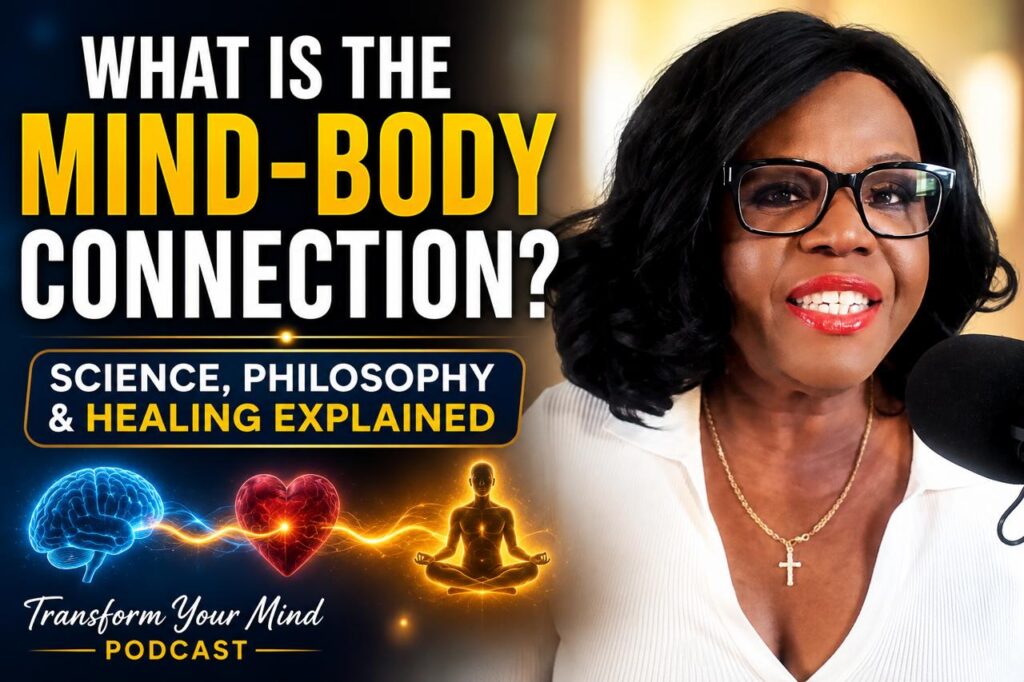
The philosophy of the mind-body connection-often called the mind-body problem-explores how our immaterial consciousness (thoughts, feelings) interacts with our physical body. It bridges ancient holistic healing with modern science, questioning whether mind and matter are separate (Dualism) or fundamentally the same thing (Physicalism).
Explore the profound connection between mind and body with Coach Myrna as she introduces a six-week series on mind-body connection. Transforming health by healing the mind. Delve into topics such as trauma’s impact on physical health, the role of suppressed emotions, and the benefits of shifting thought patterns.
Featuring insights from experts like Gabor Maté, Bruce Lipton, and Joe Dispenza, this series promises a holistic exploration of healing through psychology, biology, and spirituality. Discover how changing beliefs and understanding your body’s messages can foster true healing and transformation.
Key Takeaways
- Mind-Body Connection: Healing the mind can lead to healing the body, as physical ailments often carry emotional roots.
- Survival Strategies and Stress: Prolonged survival modes such as fight, flight, freeze, or fawn can cause chronic stress, impacting physical health.
- Holistic Healing: A holistic approach encompassing science, psychology, and spirituality offers a comprehensive path to healing.
Exploring the intricate link between the mind and body opens up new avenues for understanding chronic illnesses and psychological distress. In a powerful discussion led by Coach Myrna on the “Transform Your Mind, Transform Your Life” podcast, the central theme was how healing the mind can be a pathway to healing the body. This six-week exploration encourages listeners to identify and transform subconscious patterns of stress and trauma, which contribute to physical ailments.
The Mind-body Connection: How Trauma Manifests in the Body
The journey begins with a deep dive into the philosophy of mind-body connection “your body keeps the score.” Myrna elaborates on how trauma, often rooted in suppressed emotions and chronic stress, manifests physically. As Myrna notes, “The body remembers what your mind tries to forget.” This means that emotional experiences buried deep within can cause physical symptoms or even chronic illnesses like migraines, tension headaches, and autoimmune diseases.
This concept is supported by experts like Gabor Maté, who has studied the link between suppressed emotions and disease, and Bruce Lipton, who has explored how our beliefs impact our biology through epigenetics. We are introduced to the works of Joe Dispenza, illustrating how changing thought patterns can literally rewire the brain and support physical healing.
By examining personal experiences, Myrna resonates with many, saying, “How many of us grew up in survival mode? The body kept the receipts and then gave it back to us.” This opens up a discussion on how chronic survival strategies can lead to serious health issues over time.
The Cost of Living in Survival Mode
Expanding on the impact of these deep-seated emotional states, we take a closer look at living in continuous survival mode. When your nervous system is stuck in this state, your body emits constant signals of stress, characterized by elevated cortisol levels. “Your cortisol stays elevated, and when your cortisol stays elevated, guess what happens? You can’t sleep,” Myrna warns, pointing out how this lack of rest creates a cascade of health issues.
Importantly, Myrna presents a profound truth: “You cannot heal in the same emotional environment that made you sick.” Our thoughts act as instructions to our nervous system, dictating whether we perceive a safe or hostile world. This can have lasting effects on physical well-being, as chronic stress may become ingrained in our biological responses.
The interplay between these stress patterns and their eventual physical manifestations serves as a compelling call to action. It urges us to change our internal scripts and recognize that healing begins when we become aware of our mind-body connection. It first starts with identifying these harmful thought patterns.
A Comprehensive Healing Approach: Beyond Symptoms
Journeying further into the mind-body connection healing process, the emphasis shifts to a holistic perspective that incorporates science, psychology, and spirituality. This multidisciplinary approach brings together epigenetics, belief reprogramming, and spiritual healing practices. Week by week, the series explores diverse aspects, from emotional healing in addiction and the impacts of trauma on fertility to the role of faith and forgiveness in wellness.
Myrna states, “Healing is holistic. You are not just a body. You are not just a brain. You’re not just a diagnosis.” Embracing this holistic philosophy allows for a more integrated method of treating both mind and body. Moving beyond mere symptom management, the conversation encourages a fundamental transformation of harmful patterns.
The final weeks of exploration lay groundwork for understanding how emotions, especially those not confronted or processed, can potentially contribute to serious health issues, including cancer. Myrna reflects on the possible connections between repressed emotions, lifestyle choices, and cancer, calling for increased awareness and open conversations about these links.
Ultimately, the focus is not on blaming oneself for illnesses but on recognizing the body’s adaptive mechanisms. “Your anxiety once kept you alert. Your hyper-independence once kept you safe,” she reminds, advocating for self-compassion as one learns to process and release these emotions.
By integrating lessons from science and spirituality, this exploration paves the way for uncovering new insights about our interconnected existence. Myrna’s series leaves us with an enriched understanding of how healing the mind can set the stage for profound mind-body healing, transforming both personal and collective health landscapes.
What is the Mind-Body Connection?
Key Philosophical Perspectives
- Dualism: The belief that the mind and body are fundamentally distinct substances. Pioneered by René Descartes, this view argues the non-physical mind controls the physical machine of the body.
- Physicalism (Materialism): The view that everything is ultimately physical. In this perspective, the mind is simply the brain's physical processes, and thoughts are neural events.
- Panpsychism: The belief that consciousness is a fundamental, widespread property of all physical matter, not just the brain.
- Holism: Often favored in Eastern philosophy and modern wellness, this philosophy treats the mind, body, and spirit as completely integrated.
Week 1 – The mind-body connection to emotional eating and food addiction.
Week 2 – Sexual addiction. Turns out this comes from a failure to connect to our care givers.
Is the Mind-body Connection Scientifically Proven?
Yes, the philosophy of the mind-body connection is scientifically proven. Decades of research in fields like psychoneuroimmunology confirm that psychological states-such as thoughts, stress, and beliefs-directly alter physical health by regulating hormones, immune response, and nervous system activity.
Neuroscientific breakthroughs (such as the discovery of the Somato-Cognitive Action Network) have literally mapped how regions of the brain controlling movement are wired directly into networks responsible for planning and involuntary organ functions. Furthermore, empirical evidence demonstrates that:
- The Brain-Immune Link: Chronic stress and depression trigger the release of inflammatory chemicals and compromise the immune system, whereas mindfulness and positive health attitudes can suppress inflammation.
- Pain Perception: Psychological therapies like Cognitive Behavioral Therapy (CBT) and meditative practices physically alter the brain's pain-processing networks.
Reprogram Your MIND to HEAL YOUR BODY
Reprogramming your mind to heal your body involves leveraging the mind-body connection through techniques like mindfulness, guided imagery, and positive belief restructuring to influence physical health. By reducing stress and shifting perception, you can modulate physiological functions, enhance the immune system, and promote faster recovery alongside conventional medical care.
Key Techniques for Philosophy of Mind-Body Connection and Healing
- Mindfulness & Presence: Being aware and engaged, rather than on autopilot, helps break negative, automatic reactions that stress the body.
- Guided Imagery & Visualization: Using mental images to visualize yourself as healthy or picturing the healing process (e.g., seeing a tumor shrinking) can trigger positive physical responses.
- Rewriting the Narrative: Changing your internal dialogue from negative (e.g., "I am sick") to positive (e.g., "My body is healing") reduces stress-induced immune suppression.
- Relaxation Techniques: Practices like meditation, deep breathing, and tai chi directly combat the "fight or flight" response, lowering blood pressure and cortisol levels.
- Cell Memory Reprogramming: Some approaches focus on releasing ingrained mental, emotional, and spiritual patterns to support physical recovery.
How Does Stress Affect the Body
Stress triggers the release of hormones like cortisol and adrenaline. While helpful in short bursts, chronic stress strains your body, causing headaches, muscle tension, fatigue, and digestive issues. Long-term, it can weaken your immune system and increase your risk for heart disease, high blood pressure, and anxiety.
When your brain perceives a threat, it kicks off a cascade of physical responses. Here is how stress affects the major systems in your body:
- Heart & Circulation: Stress hormones increase your heart rate and constrict blood vessels. Over time, this can lead to hypertension (high blood pressure) and a higher risk of heart attacks or strokes.
- Digestion: The "fight-or-flight" response directs blood away from your gut. This can cause stomach pain, bloating, nausea, and conditions like irritable bowel syndrome (IBS).
- Immune System: Prolonged high levels of cortisol initially overstimulate but eventually suppress your immune system, making you more susceptible to infections and illnesses.
- Muscles & Bones: Muscles tense up to protect against injury. If stress is constant, this tension can result in severe neck and shoulder pain, backaches, and persistent headaches.
- Brain & Mental Health: Chronic stress reshapes brain function. It can affect your memory, impair decision-making, and is a major risk factor for depression and anxiety disorders.
- Metabolism & Weight: High cortisol levels can increase your appetite and cause your body to store more fat, particularly around the abdomen
What are Examples of Mind-body Connection
Physical Symptoms of Mental States
- Stress-Induced Muscle Tension: Mental strain causes your nervous system to trigger a "fight or flight" response, leading to tightened muscles, stiff necks, or tension headaches.
- Anxiety and Digestion: The gut is lined with its own extensive nervous system, often called the "second brain". Anxiety or nervousness frequently manifests physically as "butterflies," nausea, or irritable bowel syndrome (IBS).
- Depression and Fatigue: Persistent mental heaviness can cause severe physical symptoms, including unexplained body aches, chronic fatigue, and disruptions to your sleep cycle.
- Immune System Weakness: Chronic stress and negative mental states flood the body with cortisol, which suppresses your immune function and leaves you more vulnerable to illness.
Mental Impacts of Physical Actions
- Exercise-Induced Euphoria: Physical movement releases endorphins and endocannabinoids-chemicals in the brain that actively block pain and elevate mood.
- The "Mind over Milkshakes" Effect: Studies have shown that simply believing a food is healthy can cause your digestive system to process it differently compared to believing the exact same food is "unhealthy".
- Mindful Breathing and Heart Rate: Deliberately slowing your breathing cues your brain to activate the parasympathetic nervous system, naturally lowering blood pressure and reducing heart rate.
Intentional Mind-Body Practices
Many therapies and practices use physical engagement to treat mental states or cognitive focus to heal physical ailments. Common examples include:
- Yoga and Tai Chi: These disciplines use physical postures and rhythmic movement to build mental focus, increase body awareness, and reduce systemic inflammation.
- Meditation and Mindfulness: Focusing on the present moment or a single object can quiet the central nervous system, helping to manage chronic pain and lower stress.
- Cognitive Behavioral Therapy (CBT): This psychological approach teaches you to reframe negative thought patterns, which can alter your physical reactions (such as reducing physical pain responses or somatic symptoms).
- Biofeedback: A technique that helps you become more aware of-and learn to voluntarily control-your body's physical functions (like heart rate and muscle tension) using real-time electronic monitoring.
- Practice Active Awareness: Focus on the present moment, as this can reduce the stress that hinders healing.
- Change Your Internal Dialogue: Actively replace negative thoughts about your health with positive, affirming ones.
- Utilize Mind-Body Exercises: Incorporate yoga, qigong, or simple guided imagery into your daily routine.
- Complementary Approach: Use these methods alongside, not as a replacement for, necessary medical treatments.
Frequently Asked Questions (FAQ)
1. How do the mind and body affect each other?
The relationship is strictly bidirectional. A mental state (stress or anxiety) manifests physically (muscle tension, high blood pressure, weakened immunity). Conversely, physical states (chronic pain, fatigue) directly alter mental well-being.
2. Which therapies use the Philosophy of mind-body Connection?
Holistic medicine, psychology, and integrative therapy apply these concepts using practices like mindfulness, deep breathing, yoga, and progressive muscle relaxation. These techniques help regulate the central nervous system to manage pain and emotional distress.