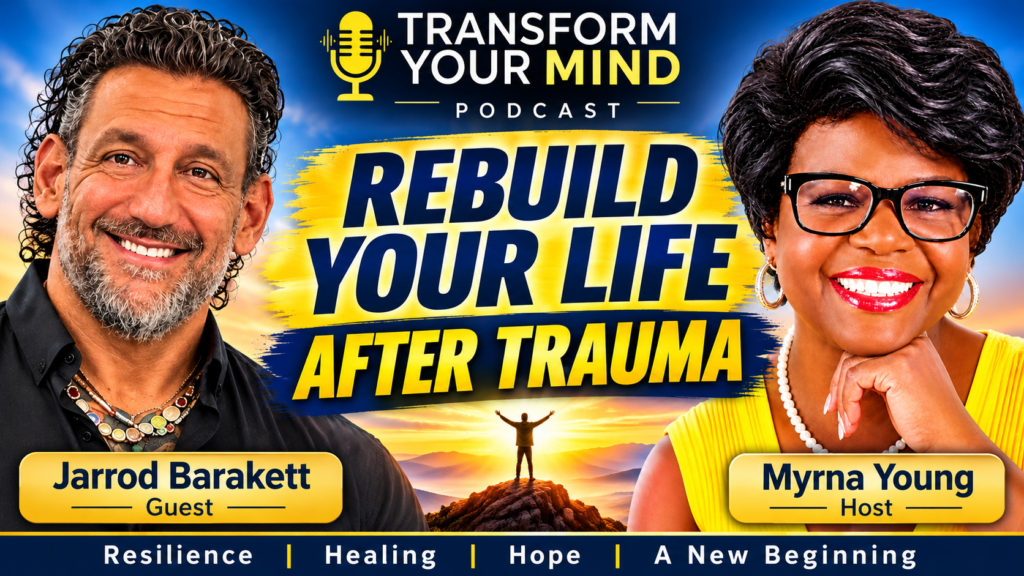
What happens when life takes away almost everything you thought defined you? How to rebuild your life after trauma: losing your career, your marriage, your health, and even your child?
Some people experience one devastating event that changes the direction of their lives. Others endure a series of tragedies that leave them wondering how much more they can take.
My guest on the Transform Your Mind Radio, Podcast, and Television Show, Jarrod Barakat, President of The Light System, experienced approximately 14 years of personal and professional setbacks that tested his physical, emotional, and spiritual strength.
He lost a successful career, experienced the death of his father, went through a difficult divorce, suffered the unimaginable loss of his daughter, faced business betrayal, and underwent emergency spinal surgery.
Yet today, Jarrod speaks about resilience, rebuilding, masculinity, and finding purpose after tragedy.
His story raises a question that many people struggling with trauma ask themselves:
How do you find the strength to keep going when your life has fallen apart?
In this episode, we explore how to rebuild your life after trauma, why emotional strength doesn’t mean suppressing grief, how visualization can help you move forward, and the role that spirituality and alternative wellness practices have played in Jarrod’s healing journey.
What You’ll Learn in This Podcast Episode
- How Jarrod rebuilt his career after losing his job and professional identity.
- Why losing his daughter changed his understanding of grief and resilience.
- How responsibility and family helped him find reasons to keep moving forward.
- What his father taught him about visualization and mental strength.
- Why healthy masculinity includes emotional vulnerability.
- How Jarrod describes light therapy, frequency, and coherence.
- Practical steps you can take when you feel emotionally, physically, or spiritually broken.
From Career Success to Personal Devastation: How to Rebuild Your Life After Trauma
[04:52] — When Everything Started Falling Apart
Before his life changed, Jarrod Barakat considered himself a successful professional.
With a degree in agricultural sciences, he built a respected career specializing in golf course maintenance. He served on industry boards, developed professional relationships, and established himself as a leader in his field.
He was also accustomed to success.
Jarrod explained that he had never interviewed for a job without receiving an offer. He had never experienced being fired.
Then, in 2010, everything changed.
A new superior entered his organization and, according to Jarrod, began undermining his position. Eventually, the ownership group decided he was no longer the right person for the job.
For someone whose identity was closely connected to professional achievement, the experience was deeply humbling.
But Jarrod made an important decision.
Rather than abandon his daily routine, he continued getting dressed every morning, going downstairs to his unfinished basement, and sitting at an old dining room table with his laptop.
He treated finding his next opportunity like a full-time job.
Eventually, former colleagues began calling. One golf course needed his expertise. Then another. Then another.
Those relationships helped him establish a successful consulting business serving golf courses across Canada. He started to rebuild his life after trauma.
The lesson: Losing a job doesn’t mean losing your value.
Sometimes the skills, relationships, and experience you’ve already developed become the foundation for your next chapter.
When you’re rebuilding after a setback, maintaining a manageable routine can provide structure during uncertainty.
You may not be able to control when the next opportunity arrives, but you can continue preparing yourself to recognize it.
When Grief Comes in Waves
[08:22] — Losing His Father and His Marriage – rebuilding life after the trauma of loss
Just as Jarrod was rebuilding his professional life, another devastating event occurred.
His father died following a nine-year battle with cancer.
Jarrod described his father as more than a parent. He was his mentor, his inspiration, and one of his closest friends.
His father had taught him discipline, visualization, and the importance of believing in his abilities.
Losing him meant losing one of the most influential people in his life.
Then came a difficult divorce.
Jarrod described sleeping on a couch for 18 months while navigating the separation and protecting his relationship with his children.
Imagine experiencing grief over losing a parent while simultaneously dealing with the emotional and financial pressures of divorce.
For many people, either experience would be enough to create significant distress.
Yet Jarrod continued working, parenting, and rebuilding.
His story illustrates something important about resilience:
You don’t always get to recover from one hardship before another arrives.
Sometimes healing and survival happen simultaneously.
You may be grieving while raising children, rebuilding your finances, or showing up for work.
That doesn’t mean your grief is unimportant.
It means that recovery often takes place in the middle of ordinary life, rather than in a perfectly protected environment.
The Unimaginable Pain of Losing a Child
[11:36] — The Tragedy That Changed Everything: How to Rebuild Your Life After Trauma
Of all the tragedies Jarrod experienced, none compared to losing his daughter.
After rebuilding his career, he accepted an opportunity in Southern California, working in the cannabis industry and eventually helping manage a growing business.
He was traveling regularly between California and Toronto to maintain his relationship with his children.
During a family boating trip, Jarrod and his wife were being pulled behind a boat on an inflatable tube.
When they fell into the water, they initially surfaced laughing.
Moments later, everything changed.
They saw another woman swimming toward them holding a life jacket and shouting that his daughter was gone.
His oldest daughter had gone over the front of the boat when it stopped, and the propeller had torn away her life jacket.
Search and rescue teams spent four days looking for her.
Jarrod and his wife repeatedly reenacted the boating route to help searchers determine where she might be.
Eventually, they received the devastating confirmation of her death.
How to Rebuild Your Life After the Trauma of Losing Your Child
As a mother, I found this part of our conversation almost impossible to comprehend.
I asked Jarrod how anyone could begin rebuilding after such a tragedy.
His answer was not that he had overcome the grief.
Instead, he explained that he had another daughter who needed him.
He also had a wife, responsibilities, and a family that depended on his presence.
Those relationships gave him a reason to keep participating in life, even when he was overwhelmed by pain.
But his determination came at a cost.
Jarrod returned to work after only two weeks.
He soon realized that he had gone back too early.
During one meeting, he became so upset with his employees that several began crying. Seeing their reactions, he broke down himself.
He apologized and took additional time away.
That moment reveals an important truth about trauma recovery.
Being able to function does not necessarily mean you have healed.
You can return to work, manage responsibilities, and appear strong while still carrying overwhelming emotional pain.
Resilience must include room for grief, not just the ability to keep working.
Emotional Strength Means Allowing Yourself to Grieve
[22:40–25:09] — What Jarrod’s Mental Health Was Really Like
During our conversation on how to rebuild your life after trauma, I wanted to understand what Jarrod was experiencing internally.
It is one thing to tell someone to keep moving forward.
It is another to explain how you survive the nights when the pain feels unbearable.
Jarrod admitted that he spent many nights screaming into a pillow and crying uncontrollably.
His wife had never seen him in that condition.
Years after losing his daughter, he still became emotional speaking about her.
He acknowledged that the loss would always be part of his life.
This is an essential distinction for anyone recovering from trauma.
Healing does not mean forgetting someone you love.
It does not mean never crying again.
And it certainly does not mean that grief disappears because you have developed a positive mindset.
Grief can return on birthdays, anniversaries, holidays, and ordinary days when something unexpectedly reminds you of the person you lost.
Sometimes the goal is not to eliminate grief but to develop the capacity to carry it while remaining connected to life.
That might include talking to trusted loved ones, attending grief counseling, participating in a support group, or creating meaningful rituals to remember someone.
For parents grieving a child, there is no universal timetable.
There is also no requirement to turn suffering into productivity.
Jarrod’s story is one example of how a person found reasons to continue. It is not a formula everyone must follow.
The takeaway: You can be strong and devastated at the same time.
Visualization: The Mental Tool His Father Taught Him
[22:40] — How to Rebuild Your Life After Trauma: Training the Mind Before the Challenge
One of the most fascinating parts of Jarrod’s story was the influence of his father.
As a young athlete, Jarrod would lie on the living room floor with his father before sporting events.
Together, they would mentally rehearse every play, goal, race, and possible outcome.
His father wanted him to picture success before stepping onto the field.
The lesson stayed with him into adulthood.
During our conversation, Jarrod compared life to golf.
If you hit a ball into the water or a bunker, spending the rest of the round dwelling on that mistake will not improve your next shot.
You must focus on what comes next.
I loved that analogy because it captures the foundation of personal transformation.
You cannot change the shot you already made.
But you can influence how you approach the next one.
Visualization can be a useful mental practice because it helps you imagine specific actions, prepare for challenges, and clarify your goals.
Athletes use mental rehearsal to complement physical training, but the principle can also be applied to everyday life.
For example, someone recovering from a divorce might visualize confidently attending a social gathering.
A person rebuilding a career might mentally rehearse a successful interview.
Someone healing from trauma might imagine setting a healthy boundary or responding calmly to a difficult situation.
Visualization cannot guarantee outcomes or erase traumatic memories.
However, when paired with realistic planning and action, it can help people approach the future with greater intention.
Affiliate Ad

A Simple Visualization Exercise
Find a quiet place and sit comfortably.
Close your eyes and imagine yourself six months from now.
Ask yourself:
What would emotional progress look like?
How would I respond differently to challenges?
What healthy habit would I have developed?
Who would I be spending time with?
What is one action I can take today to move toward that future?
Spend a few minutes picturing yourself completing that action.
Then write down one practical step you can take.
Remember, visualization becomes more useful when it inspires behavior.
Redefining Masculinity and Emotional Strength
[34:40] — What Does It Really Mean to Be Strong?
Another important theme in our conversation was masculinity. How do men rebuild their life after trauma?
Jarrod believes that providing for and protecting loved ones are important responsibilities for men.
He described being attentive to his wife and daughter, looking out for their safety, and taking pride in being a dependable husband and father.
But his story also reveals a broader understanding of strength.
He openly discussed crying, emotional devastation, and the moments when he struggled to cope.
That vulnerability challenges the belief that strong men should never show emotion.
Healthy masculinity does not have to mean emotional suppression.
A man can be protective and compassionate.
He can be physically strong and emotionally vulnerable.
He can provide for his family while also acknowledging that he needs support.
These qualities are not contradictions.
They can complement one another.
One of the most valuable lessons from Jarrod’s experience is that strength involves recognizing when your current approach is not working.
Returning to work too soon after his daughter’s death was not sustainable.
Taking additional time away required self-awareness.
For anyone navigating grief or trauma, emotional strength may look like asking for help, acknowledging exhaustion, or allowing someone else to support you.
Sometimes the strongest thing you can do is admit that you’re hurting.
How to Rebuild Your Life After Trauma: Finding Purpose Through Responsibility and Connection
[32:38] — Why Jarrod Kept Moving Forward
When I asked Jarrod what he told himself to begin rebuilding his life after the death of his daughter, his answer surprised me.
He said he never had a dramatic conversation with himself about becoming stronger.
Instead, he focused on his daily responsibilities.
His daughter still needed to be picked up from school.
She needed help with homework.
His wife needed her husband.
His business required attention.
For Jarrod, caring for his family also became a way of caring for himself.
This illustrates how purpose can help people maintain a connection to life during difficult seasons.
Purpose does not always have to be something enormous.
It may be raising your children, caring for a pet, helping a neighbor, maintaining a garden, or simply getting outside for a daily walk.
Small responsibilities can create meaningful structure.
However, there is an important balance.
Being needed by others can motivate recovery, but your worth is not dependent on how productive or useful you are.
People who are grieving deserve care even when they cannot work, provide, or meet everyone’s expectations.
If you’re rebuilding life after trauma, consider identifying one small reason to participate in tomorrow.
It doesn’t have to solve your problems.
It simply needs to give you a place to begin.
Physical Trauma and the Search for Healing
[17:32–21:09] — Emergency Spinal Surgery
Jarrod’s challenges did not end with the loss of his daughter or any of the other challenges he faced.
After returning to Canada during the COVID-19 border restrictions, he discovered that his business partner had been selling company assets to support drug and gambling problems.
He eventually returned to professional relationships in the golf industry and explored new opportunities.
Then his physical health deteriorated.
He began experiencing significant back pain, followed by numbness and difficulty controlling his legs.
While playing baseball, he noticed that he was falling because his legs could not keep up with his movements.
An MRI revealed severe spinal cord compression.
Doctors warned that he was dangerously close to paralysis.
Jarrod underwent emergency spinal surgery.
His surgeon advised him to stay out of the gym for six months.
During recovery, Jarrod became involved with a company promoting a light-based wellness technology.
He later began using the equipment at home.
He reported experiencing improvement in how he felt and returning to the gym earlier than expected.
He attributes part of his recovery experience to the technology.
However, his personal experience cannot establish that the system caused his improvement. Recovery following spinal surgery is influenced by many factors, including the surgery itself, rehabilitation, and individual healing.
Anyone recovering from spinal surgery should follow their medical team’s recommendations before resuming strenuous exercise.
Still, Jarrod’s experience opened the door to an interesting discussion about light, frequency, and the mind-body connection.
Understanding Light Therapy, Frequency, and Coherence
[38:10] — How to Rebuild Your Life After Trauma with The Light System
Today, Jarrod serves as President of The Light System, a company offering technology built around light, frequency-related concepts, and coded affirmations.
During our interview, he described three central components of the system.
1. Polychromatic Light Therapy
Polychromatic means involving multiple colors or wavelengths of light.
Jarrod explained that the technology uses different colors rather than relying exclusively on red light.
Light does influence human biology.
For example, exposure to natural daylight helps regulate the body’s circadian rhythm, which affects sleep and wakefulness.
Bright light therapy also has established applications for certain conditions, including seasonal affective disorder.
However, different colors of light cannot automatically be assumed to treat specific organs, diseases, or emotional conditions.
Claims about the therapeutic benefits of a particular device require research on that device and the outcomes being claimed.
2. Biphotonic Collisions
Jarrod described a process in which light emitted from opposing screens interacts within the system.
He believes this interaction supports cellular electrical activity and helps the body function more efficiently.
He compared the process to replenishing an energy tank.
It is an interesting metaphor, particularly when discussing exhaustion and chronic stress.
However, the claim that colliding photons from this system replenish cellular energy or treat illness has not been established by the interview.
Human cells do depend on electrical and chemical processes, but that does not demonstrate that this technology produces the health effects described.
3. Coded Affirmations and Coherence
The third component involves affirmations displayed in coded formats.
Jarrod connects this concept to the belief that words, thoughts, and frequencies can influence water and the human body.
He referenced experiments associated with Masaru Emoto, whose claims about words and water crystals have not been established through rigorous, reproducible scientific evidence.
Positive self-talk and affirmations can still have psychological value.
For some people, they help reinforce goals, encourage self-compassion, and interrupt negative thinking patterns.
But this is different from demonstrating that affirmations physically restructure water inside human cells.
What Is Coherence?
In general, coherence refers to elements operating in an organized or coordinated way.
In physiology, researchers use specific measurements to examine patterns such as heart rhythms and nervous system activity.
In meditation and wellness discussions, the word is sometimes used more broadly to describe a sense of mental and emotional alignment.
When Jarrod discusses coherence, he is describing his belief that the body functions better when its energy and internal processes are harmonized.
That is his framework for understanding the technology, rather than a clinically established explanation of its effects.
For listeners interested in exploring The Light System, the important questions are what evidence supports its claims, what benefits have been measured, and whether it has been evaluated for safety and effectiveness.
Complementary wellness practices should not replace necessary medical or mental health treatment.
The Power of Words and Positive Self-Talk
[45:18] — Are Your Thoughts Helping or Hurting You?
One part of our conversation that particularly interested me was the discussion about affirmations.
I asked Jarrod whether saying something positive could make a difference if you didn’t actually believe it.
For example, what happens when someone says, “I am healthy,” while struggling with a serious health condition?
The deeper question is whether affirmations need to feel believable to be useful.
From a psychological perspective, positive self-talk may help some people manage stress and learn how to rebuild your life after trauma.
But affirmations that feel completely disconnected from reality can sometimes create resistance.
Instead of insisting, “Everything in my life is perfect,” you might try:
“I am learning to take better care of myself.”
“I can ask for support when I need it.”
“My circumstances are difficult, but I can take one constructive step today.”
“I deserve compassion while I heal.”
These statements acknowledge reality while encouraging progress.
As a trauma recovery coach, I believe the language we use to describe ourselves deserves attention.
There is a difference between saying, “I experienced something terrible,” and defining yourself entirely by what happened.
Your experiences are part of your story.
They do not have to become your entire identity.
How to Begin Rebuilding Your Life After Trauma
[48:40] — The First Step Toward Healing
Near the end of our conversation, I asked Jarrod what advice he would give someone who currently feels emotionally, physically, or spiritually broken.
His message centered on looking forward.
He acknowledged that not every day is happy.
He still misses his daughter, especially during meaningful occasions such as birthdays.
But he believes that continuing to look toward the future has helped him remain connected to hope.
I would add that moving forward does not require leaving your grief behind.
You can honor your past while creating space for new experiences.
Here are five practical steps to consider.
Step 1: Acknowledge What Happened
You cannot heal by pretending your pain does not exist.
Give yourself permission to recognize your losses, feelings, and needs without judging how quickly you should recover.
Step 2: Rebuild One Daily Routine
Start small.
Take a morning walk, eat regular meals, practice meditation, or establish a consistent bedtime.
Simple routines can create stability when life feels unpredictable.
Step 3: Stay Connected to Support
Healing is not something you must accomplish alone.
Reach out to someone you trust, consider professional counseling, or connect with others who understand your experience.
Step 4: Visualize Your Next Chapter
Instead of trying to solve your entire future, imagine one meaningful improvement.
What would make your life feel a little more manageable?
Then identify the next realistic action.
Step 5: Allow Hope and Grief to Coexist
You do not have to choose between remembering what you lost and appreciating what remains.
There can be moments of gratitude, laughter, and connection even while grief continues.
Recovery is rarely linear. Some days will be harder than others, and that does not mean you have failed.
My Final Thoughts on How to Rebuild Your Life after Trauma: This Too Shall Pass
[50:07] — Finding Hope in Difficult Seasons
During our conversation, I shared a saying that has helped me navigate life’s challenges:
“This too shall pass.”
What makes this statement meaningful is that it applies to both good and difficult seasons.
Life is constantly changing.
We experience beginnings and endings, success and disappointment, joy and sorrow.
Some losses remain with us permanently, but the intensity and shape of our experiences can change over time.
Jarrod’s story reminds me that rebuilding your life does not always mean returning to who you were before tragedy.
Sometimes it means discovering who you are becoming because of everything you have survived.
I also believe there is a difference between being knocked down and deciding that your story is over.
You may not have chosen what happened to you.
But with time, support, and compassion, you may discover new possibilities for how you want to live.
Jarrod ended our conversation by explaining that one of the most rewarding aspects of his experience is the opportunity to help others who are going through difficult circumstances.
That is where personal pain can sometimes become meaningful service.
Not because suffering was necessary or deserved, but because what we learn through surviving it may help someone else feel less alone.
And that is the heart of transformation.
You cannot always change what happened to you, but you can continue shaping what happens next.
Listen to the Full Podcast Episode
From Darkness to Light: Rebuilding a Life Through Resilience, Masculinity, and Healing — with Jarrod Barakat
Join Myrna Young and Jarrod Barakat on the Transform Your Mind Radio, Podcast, and Television Show for this deeply personal conversation about grief, family, resilience, spirituality, and rebuilding after loss.
Download the episode Here:
Episode Timestamps
- [02:20] Introduction: When life falls apart, how do you begin again?
- [04:52] Losing a successful career and rebuilding through consulting.
- [08:22] The death of Jarrod’s father and a difficult divorce.
- [11:36] The boating tragedy that took his daughter’s life.
- [13:46] Returning to work too soon after devastating grief.
- [17:32] Business setbacks and emergency spinal surgery.
- [22:40] Visualization and the lessons Jarrod learned from his father.
- [24:29] The emotional reality of grieving a child.
- [32:38] How family responsibilities helped Jarrod keep going.
- [34:40] Masculinity, providing, protecting, and emotional strength.
- [38:10] Light therapy, frequencies, and The Light System.
- [43:20] Coherence, coded affirmations, and mind-body beliefs.
- [48:40] The first step toward rebuilding when you feel broken.
- [50:07] Myrna’s reflection on the power of “This too shall pass.”
- [52:28] Where to learn more about Jarrod and The Light System.
Connect With Jarrod Barakat
Learn more about Jarrod’s work and explore The Light System through the following resources mentioned during the interview.
Website: The Light System
Instagram: @thelight.system
Marketplace: TLS Marketplace (tlsmarketplace.shop)
The discussion of The Light System reflects the guest’s experiences and product descriptions. It is provided for informational purposes and is not a medical endorsement.
Join the Conversation
Have you ever experienced a season when everything seemed to fall apart?
What helped you find the strength to begin again?
Share your thoughts in the comments. Your experience may encourage someone who is struggling to see a future beyond their current circumstances.
For more conversations about trauma recovery, mental health, mindset, and longevity, explore additional episodes of the Transform Your Mind Podcast at myhelps.us.
Remember, transformation begins in the mind, but healing is a journey that involves the whole person.
Until next time, Namaste.
Additional Resources
Want to Be a Guest on Transform Your Mind?
Are you an author, coach, health expert, or thought leader with a powerful message to share?
Transform Your Mind Radio, Podcast, and Television Show features meaningful conversations about mindset, mental health, personal transformation, and longevity.
We welcome applications from experts who can bring valuable insights to our audience.
Apply to Be a Podcast Guest: https://myhelps.us/guest/