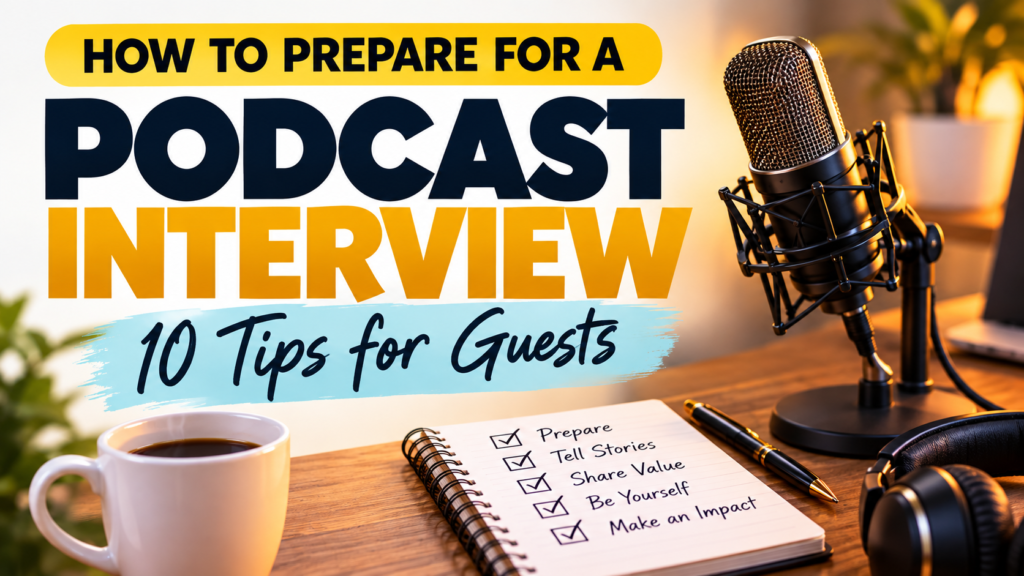
How to prepare for a podcast interview: Learn how to prepare your message, tell memorable stories, improve your audio and video, and make your next podcast appearance stand out.Being invited to appear on a podcast is an opportunity to share your expertise, tell your story, and introduce yourself to a new audience. But a great podcast interview doesn’t happen simply because you know your subject.The best guests arrive prepared—not with scripted answers, but with a clear understanding of what they want listeners to remember.Whether you’re an author promoting a new book, an expert building your
personal brand, a business owner, coach, or thought leader, these tips will help you prepare for a podcast interview that delivers value to both the host and the audience.
1. How to Prepare for a Podcast Interview: Listen to the Podcast Before Your Interview
Before appearing on a podcast, listen to at least one or two recent episodes.Pay attention to the host’s interview style. Are the conversations educational, conversational, inspirational, or highly structured? How long are the interviews? What kinds of questions does the host ask?Understanding the show helps you enter the conversation prepared for its audience rather than delivering the same interview you give everywhere else.On the Transform Your Mind podcast, I bring my
Life coaching skills to the interview.That means I pick up the breadcrumbs you leave and add a follow-up question.I send out a show outline because I want you to be prepared for the tough questions.My interview style is conversational.
2. Know the Audience You Are Speaking To
How to prepare for a podcast interview, a great podcast guest doesn’t speak only to the host. You are speaking to everyone listening.Ask yourself:
Who listens to this show, and what can I teach them that will make their lives better?Knowing the audience helps you choose stories, examples, and advice that will resonate with the people you actually want to reach.This is important because if I have a mostly female audience then your answers must apply to women.I also have an audience looking for
self-improvement topics, so we don’t want to delve too much into the science of things.
3. How to Prepare for a Podcast Interview: Identify Your Three Most Important Takeaways
You don’t need to memorize answers, but you should know the three things you most want listeners to remember.These might be an important idea from your book, a lesson from your personal experience, a misconception you want to challenge, or a practical strategy listeners can use immediately.Think of these as your
message pillars. Whatever direction the conversation takes, they help you remain focused.A lot of my guests would insert these messages into a totally irrelevant question because they want to get them in.I am not saying to stick them in when you have an opportunity, that is not the right approach.At the end of the interview the host always asks you to talk about what you are promoting.This is where if the host has not asked you about your core messages, you can talk about them here.
4. Prepare Stories, Not Speeches
Facts educate.
Stories connect.Preparing for your interview: Instead of preparing long explanations, think about two or three stories that illustrate your expertise.What happened? What did you learn? What changed? What can the listener learn from your experience?A compelling story will often stay with listeners long after they’ve forgotten a statistic.Your origin story is golden, and I usually start off the conversation asking about how you started doing what you are doing.Make this no more than 5 mins.I remember asking a guest about their origin story and 20 mins later she was still talking.I tried interrupting her, but she was hell bent on sharing every last bit of her story.That was not a good interview, nobody listens to a podcast to hear a monologue, they listen for the conversation.
5. How to Prepare for a Podcast Interview: Create a Professional Guest One-Sheet
This is the number one tool in your tool belt if you want to get booked on podcasts.I screen all my guests from a one-sheet that includes Bio, sample topics, sample questions and social media links.Make it easy for the host to prepare for your interview.I use your one-sheet to create my show outline. I do not use every question, but it gives me the framework.A good podcast guest one-sheet should include your
professional bio, headshot, areas of expertise, suggested interview topics, possible questions, book or product information, website, and social-media links.Your one-sheet isn’t a script for the host. It is a resource that helps them create a stronger conversation.
6. Test Your Technology Before Recording
Poor audio can ruin an otherwise excellent interview.Don’t show up for an interview with me recording on your phone.Some of the big-name podcasts you have to fly to visit them in person.The
Diary of a CEO podcast films in London.They do this because guests are always coming for an interview with poor audio and video.Test your microphone, headphones, camera, lighting, and internet connection before recording day. Choose a quiet room and eliminate notifications, phones, fans, televisions, and anything else that could interrupt the conversation.If the interview includes video, position your camera at eye level and make sure your face is well lit.Professional presentation communicates that you respect both the host and the audience.
7. Don’t Turn the Interview into a Commercial
This is one of the biggest mistakes podcast guests make.Listeners didn’t press play to hear a 30-minute sales pitch.
Teach first.Give the audience useful information. Tell great stories. Answer the questions fully. When listeners receive genuine value from you, they naturally become curious about your book, business, service, or expertise.The interview itself should make them want to learn more.Guests come on my show and the first question I ask them they are running a commercial for their book.They would say things like “This is in my book” or “That is why I wrote the book”Or when I ask them for 6 questions all the questions are about them!No, my listeners are trying to get tips and strategies to have a successful life.That is why they listen to podcasts.You have 5 mins at the end of the show for your commercial, not 60 mins.
8. Prepare One Clear Call to Action
When the host asks where listeners can find you, don’t give them six websites, four social-media accounts, two books, and a complicated URL.Choose
one primary next step.It might be your website, book, free resource, course, or another destination specifically created for podcast listeners.Make it simple enough that someone can remember it while driving or walking.I ask for your website and social media handles.Anything else you have, I add to the show notes.
9. Be Present and Have a Conversation
Some of the best podcast moments are unexpected.Don’t become so focused on delivering your prepared talking points that you stop listening to the host.Answer the question being asked. Allow yourself to laugh. Pause. Tell the story that suddenly comes to mind.Preparation gives you confidence—but
conversation creates connection.
10. Promote Your Podcast Appearance
Your work isn’t finished when the recording ends.When your episode is published, share it with your audience through social media, your website, newsletter, and other appropriate channels. Tag the host and podcast when you share.Promotion benefits everyone: you, the host, and the listeners who might never have discovered the conversation otherwise.And remember that a podcast interview is an evergreen media asset. Add strong appearances to your media page or website and continue sharing them long after publication.This is where 90% of guests drop the ball.They don’t promote the interview, they don’t promote the show, they don’t leave a review, they don’t comment on the social media posts. Nothing!I don’t understand this reasoning.That is why the podcast industry is moving towards pay to play.
What Makes a Great Podcast Guest?
The best podcast guests don’t simply promote themselves. They
serve the audience.They arrive prepared, share useful ideas, tell memorable stories, engage naturally with the host, and help promote the conversation afterward.Your goal isn’t simply to
appear on a podcast.Your goal is to create a conversation worth remembering.
Additional Resources for Podcast Guests
The Business of Podcasting: From Hobby to SuccessHow to Create a Podcast Guest One-Sheet
[future/existing article]
How Authors Can Use Podcast Interviews to Promote Their Books
[future article]