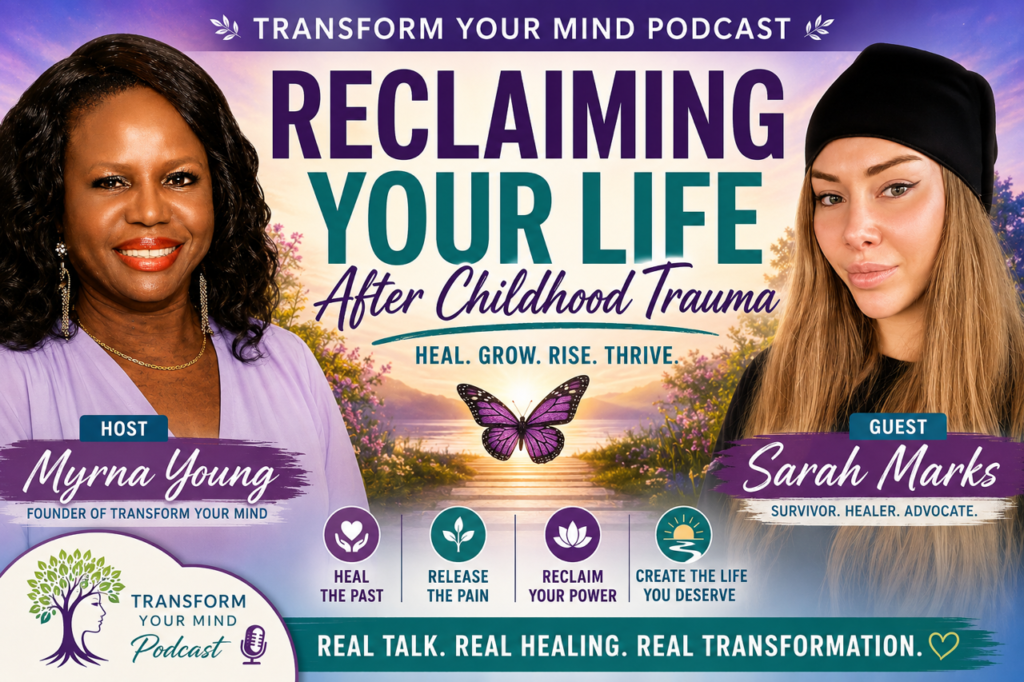
Join host Myrna Young on the Transform Your Mind podcast as she interviews Sarah Marks about her journey from trauma to transcendence and profound awakening. Discover how Sarah survived childhood abuse and human trafficking, eventually transcending her experiences to explore human consciousness and spirituality.
Learn how one’s DNA can act as a “biological Internet,” connecting us to higher intelligence and fostering personal growth. This podcast episode delves into healing, intuition, and the intersection of science and spirituality, offering insights for anyone seeking a deeper level of awareness and connection.
Key Takeaways
- Trauma doesn't define your future; the real transformation begins when you tap into the intelligence within yourself.
- Traumatic transcendence involves understanding duality and embracing both positive and negative experiences simultaneously.
- Your mind is much more powerful than you think, and the journey to trust it again starts with gentleness and awareness.
Understanding Traumatic Transcendence and Path to Recovery
In the depths of personal struggles, many find themselves seeking a light to guide them out of their darkness. This is where the conversation between Myrna, a life coach, and Sarah, an inspirational figure who navigated her way out of traumatic experiences into Traumatic transcendence.
Their discussion on the “Transform Your Mind“ podcast unravels complex themes surrounding trauma, healing, and transcendence. “Healing is not just about surviving what happened to you; it’s about rediscovering who you were always meant to be,” Myrna articulates, setting the stage for profound exploration.
The first significant theme from this enlightening dialogue is the journey through trauma and back. Sarah’s account of surviving severe childhood abuse and human trafficking is gripping. Reflecting on her early years, she notes, “I had happy memories, but in another sense, it was very shut down and a very dark experience for me.”
Sarah’s openness about the gradual recollection of her past illustrates the pervasive nature of trauma and its ability to distort reality, akin to “looking back at a cracked mirror.” This metaphor vividly captures how trauma can alter one’s perception. Necessitating a process of healing that involves piecing those shards back into traumatic transcendence.
The broader implications of this discussion underscore the critical importance of acknowledging and addressing trauma. It is essential to recognize how unresolved trauma can lead to destructive behaviors, a spiral Sarah knows too well, having dealt with addiction and serious health scares. But survival isn’t the end; healing requires work, patience, and self-compassion-a notion reiterated throughout Sarah’s narrative.
The Duality of Healing: Experiencing Presence and Transformation
An equally insightful revelation from the conversation involves the concept of duality in healing. Sarah explains, “For every negative thing, there’s a positive. There’s always a counter to everything.” This understanding is pivotal for those seeking recovery, emphasizing that both light and darkness exist simultaneously. The practice of somatic work is highlighted as instrumental in this journey, offering tangible means to confront and balance the conflicting emotions and experiences within oneself.
Myrna’s inquiry about somatic healing elicits an enthusiastic response from Sarah, who emphasizes its transformative power. Somatic techniques help individuals differentiate between the fear induced by trauma and the reality. By fostering a sense of presence-being fully aware of one’s surroundings and inner state-individuals can gradually mend their internal fractures and foster resilience. The emphasis here is on “gentle and slow” approaches to reestablishing self-trust and inner harmony, mirroring Sarah’s own trajectory from a shattered past to a reawakened present.
The implications of embracing duality are profound. Offering a pathway not only to individual healing but also to collective understanding. Presence and awareness, as stressed by Sarah, foster a holistic view of humanity’s interconnectedness. And the innate potential for traumatic transcendence through mindful living.
Reclaiming Intuition and Trust Through Traumatic transcendence
Finally, an essential theme revolves around rebuilding trust in intuition after trauma-a fundamental step in personal transformation. Sarah’s journey is illustrative, from feeling fragmented and detached to learning to trust her gut instincts once again. “You gotta learn to trust yourself again,” she asserts. Underscoring that trauma often severs this intrinsic connection.
Myrna agrees, noting, “Where in your life are you called to reconnect with yourself, your intuition, or your higher power?” This reflective question challenges listeners to assess where they have strayed from self-trust. Through practices such as somatic therapy and meditation, one can peel back the layers of fear and distortion, reshaping a life dictated not by past trauma but by newfound self-awareness and agency.
The conversation spotlights the broader impact of regaining trust in one’s intuition: it empowers individuals to not only heal themselves but also contribute positively to those around them. As Sarah deftly illustrates with her life’s work, when we heal, we unlock the potential to transform, inspire, and support others in their healing journeys.
Living beyond trauma is more than survival; it’s about significant awakening and introspection. Through gentle self-compassion and intentional presence, the fragmented pieces of one’s past can reunite into a coherent narrative that aligns with hidden capacities and potentials. “You are far more powerful, connected, and intelligent than you’ve been led to believe,” Myrna posits, encapsulating the transformative essence of their dialogue and inviting a broader audience to embark on their own paths of inner discovery and healing.
Signs of Traumatic Transcendence
- The Three Signs of Transcendence: Rooted in ancient wisdom philosophies like Vedanta, true healing is measured by three key shifts: a decrease in the frequency of mental agitation when triggered, a reduction in the intensity of emotional pain, and a quicker recovery time to return to a baseline of peace.
- Posttraumatic Growth: Research indicates that a vast majority of people experience growth after severe adversity. This shift occurs when traumatic experiences cause us to question our fundamental assumptions about reality, opening a gateway to profound personal and psychological evolution.
- The Four Stages of Healing: Dr. Keith Witt outlines a practical, sequential progression: face the trauma, adjust your life story, change habits of attention from negative to positive, and use the trauma to enhance personal evolution.
- Transcending the Self: By looking beyond the confines of the suffering individual self, people often find a greater purpose-such as deep concern for others, flow, and compassion—which supersedes and reduces the saliency of fear and despair.
Frequently Asked Questions
1. What is the difference between “getting over” trauma and transcending it?
2. What does post-traumatic growth actually look like?
- Steady Wisdom: The intensity of your pain decreases, and the mental agitation from triggers happens less frequently.
- Cognitive Reframing: You gain the ability to recontextualize suffering as something comprehensible, which allows you to extract valuable life lessons.
- Enhanced Empathy: Many individuals turn their pain outward, using their personal understanding of hardship to connect with and help others.
3. How can a traumatic event spark spiritual evolution?
4. What therapeutic methods help in this journey?
- EMDR (Eye Movement Desensitization and Reprocessing)
- Somatic / Nervous System Regulation (Calibrating the body to feel safe)
- Mindfulness & Meditation
Additional Resources
- Annka Website
- Instagram: @arnicaofficial
- PodCast Transcript