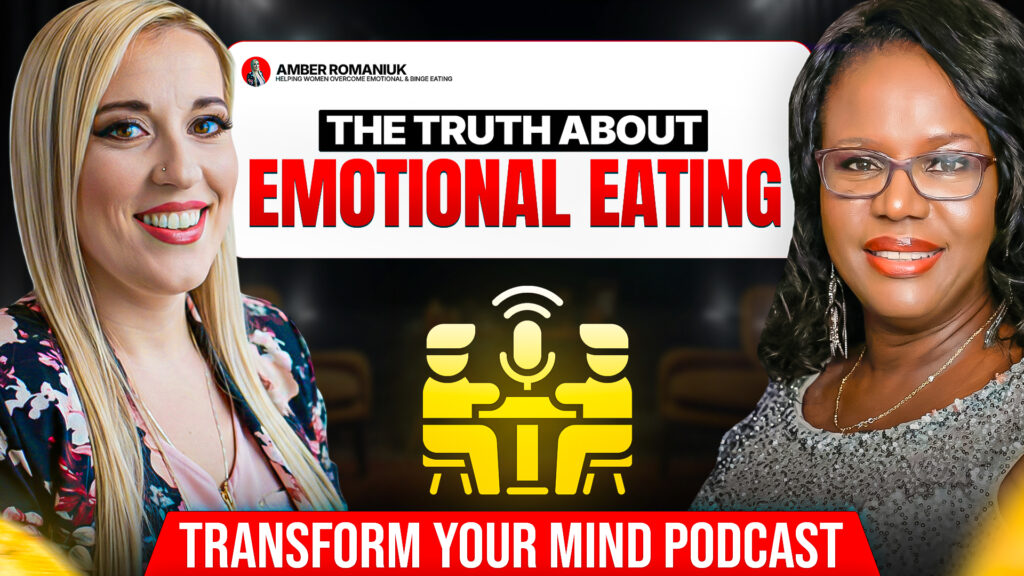
Myrna Young welcomes Amber Romaniuk, an emotional eating expert, to explore how to stop emotional eating. Why past experiences and emotional triggers contribute to eating disorders like binge eating, emotional eating, and food addiction.
Amber shares her personal journey of healing her emotional eating, highlighting the importance of mindset, self-care, and understanding triggers. They discuss the impacts of cortisol and stress on emotional eating and the vital role of self-awareness in healing emotional eating.
Tune in to discover actionable insights into transforming your relationship with food and body image.
Download the PodCast
Key Takeaways
- Understanding Emotional Eating: Distinguishing binge eating, emotional eating, and food addiction can change your approach to wellness.
- Empathic Triggers: Discover how being an empath could induce emotional eating and what that means for your emotional and physical health.
- Path to Body Freedom: Learn how mindset shifts and self-awareness can lead to healing and a healthier relationship with food.
Navigating the complexities of healing emotional eating and food addiction. A journey that requires more than just surface-level understanding.
As we delve into the stories and experiences shared by Myrna Young, a life coach, and Amber Romaniuk, an expert in emotional eating and hormonal balance, we uncover the deep-rooted influences and the path to reclaiming power over these challenges. Through their candid discussion, we aim to shed light on differentiating emotional eating, the triggers related to being an empath, and the path to achieving body freedom through mindset transformation.
Stop Emotional Eating: What if Weight Loss Isn’t about the Food?
Decoding Emotional Eating, Binge Eating, and Food Addiction
Understanding emotional eating begins with recognizing how it differs from binge eating and food addiction. The act of consuming food for reasons beyond physical nourishment-whether it’s triggered by boredom, loneliness, or celebration-defines emotional eating. As Amber explains, “Food was always available, so I could eat whatever I wanted, whenever I wanted… it was just kind of a free-for-all.” This behavior often spirals into binge eating, where control over consumption is temporarily lost. As Amber recounts her experience, “After I ate the ice cream cake, it triggered the all-or-nothing mentality… eat whatever I want… then it was fast food, and before I knew it, until I was so full, I was sick.”
This marks a critical shift from mere healing emotional eating to a more severe, compulsive behavior.

Finally, when our fixation with food occupies our thoughts and dictates our actions, it evolves into an addiction. Amber’s insight-“You’re constantly non-stop thinking about food numbers… your next diet… obsessed with food and your weight”-highlights how profound and consuming this fixation can become. Each of these issues must be contextualized within the broader spectrum of behavioral and psychological factors-stemming from self-worth to inherited habits, they underscore a need for comprehensive and tailored intervention strategies.
Sponsored Ad
Therapy with NOCD is also accessible: Sessions are 100% virtual, it’s covered by insurance for over 138 million Americans, and you get support between sessions so you’re never facing OCD alone.
f you’re struggling with OCD or unrelenting intrusive thoughts, NOCD can help. Book a free 15-minute call to get started: Because healing the mind can truly change your life. https://learn.nocd.com/transform
Because healing the mind can truly change your life.
Exploring Empathic Triggers: Stop Emotional Eating
Empaths are individuals who deeply feel and absorb the emotional states of others, which can unknowingly lead them to food, using it as an emotional buffer. As Amber details, “When your friend dumps all their stuff on you, and you feel their sadness… and then you want to go and eat,” this behavior exemplifies the intense internalization of external emotions. For empaths, the compounding stress of feeling too deeply necessitates viable coping mechanisms. Many reach for food to suppress or manage these heightened emotional states. Amber provides critical strategies, emphasizing that, “Setting healthy boundaries, learning how to manage your intuition… and taking time to process your emotions are incredibly important.”
Understanding that the pathway to healing involves developing emotional resilience and the ability to self-regulate beyond food dependencies, we learn that practices like mindfulness, self-care, and boundary-setting play essential roles.
These insights emphasize an often-overlooked aspect of emotional eating: the need for empaths to cultivate a strong internal locus of control.
Sponsored Ad
- Spark Energy + Focus is your go-to pre-workout ritual when you need reliable energy to power through a lift, ride, run, or class. Mix it, sip it, and get dialed in and ready to go!
- With 0g of sugar, and essential vitamins and amino acids for mental focus, Spark supports reliable, sustained energy and focus without that jittery spike-and-crash feeling.
- Make it your go-to pick-me-up for the 2 pm slump or swap coffee for Spark to start the day strong.
Spark Energy + Focus is offering 30% off and free shipping. Go to https://www.drinkspark.com/and use code TRANSFORM at checkout.
The Journey to Body Freedom and Mental Well-being
Achieving body freedom is about more than physical health-it’s an integration of mindset, habits, and emotional well-being. Amber highlights key tactics for initiating this journey, starting with the empowerment that comes with self-awareness and choice. She asserts, “Before I go to food, is this physical or emotional hunger?”- a simple yet profound question that encourages reflection and conscious decision-making.
Another fundamental aspect is the rewiring of neural pathways-the habitual behaviors that drive these eating patterns to understand how to stop emotional eating.
“Every time you repeat a habit… you’re literally wiring a neural pathway in your brain,” Amber illuminates the science of behavior. By interrupting these patterns and forming new habits, individuals can reclaim control and develop healthier relationships with food. The broader implications of this journey are transformative. By addressing not just the symptoms, but the root causes of emotional and psychological distress, individuals can experience profound empowerment. Amber’s success story serves as a beacon of hope: “I don’t eat emotionally anymore… I healed my relationship with food, and gained a new life. ”In their candid conversation, Myrna and Amber underscore the significant personal, physical, and emotional benefits that accompany this healing journey. It’s a reminder that transformation is possible for anyone willing to take the first step. Achieving balance with food, dissolving damaging patterns, and cultivating self-love transforms not just the relationship with food, but overall life satisfaction and emotional health. Through awareness, accountability, and a commitment to self-compassion, individuals are empowered to embark on the journey of healing and ultimately claim a life of freedom and self-assuredness.

Weight Loss: Gain Control of Emotional Eating
Find out how emotional eating can derail your weight-loss efforts, and get tips to manage your eating habits.
By Mayo Clinic Staff
Jan. 21, 2026
You may feel the strongest food cravings hit when you’re at your weakest point emotionally. You may turn to food for comfort when facing a difficult problem, feeling stressed or even feeling bored. Emotional eating can hurt your weight-loss efforts. It often leads to eating too much, especially high-calorie, sweet and fatty foods. The good news is that you can take steps to better manage your eating habits and get back on track with your weight-loss goals.
How the Mood-food-weight Loss Cycle Works
Emotional eating is eating to feel better when you’re upset, such as when you’re stressed, angry, scared, bored or lonely. Major life events or, more commonly, everyday hassles can trigger negative emotions that lead to emotional eating and disrupt your weight-loss efforts. These triggers might include:
- Relationship conflicts.
- Work or other stressors.
- Fatigue.
- Money issues.
- Health concerns.
Some people also overeat in response to positive emotions. While some people eat less in the face of strong emotions, if you’re having a hard time emotionally, you might turn to impulsive or binge eating. You might quickly consume whatever’s nearby without enjoyment. In fact, your feelings can become so tied to your eating habits that you automatically reach for a treat whenever you’re angry or stressed. You may do this without thinking about it. Food also serves as a distraction. If you’re worried about an upcoming event or struggling with a relationship, you may focus on eating comfort food instead of dealing with the painful situation. Whatever emotions drive you to overeat, the end result is often the same. The effect of emotional eating is short-term. The emotions return and you likely feel guilty about setting back your weight-loss goal. This can lead to an unhealthy cycle where your emotions trigger you to overeat, you beat yourself up for getting off your weight-loss track, you feel bad and you overeat again.
How to Stop Emotional Eating and Get Back on Track
When negative feelings threaten to trigger emotional eating, you can take steps to manage cravings. To help stop emotional eating, try these tips:
Keep a food diary.
Write down what you eat, how much you eat, when you eat, how you’re feeling when you eat and how hungry you are. Over time, you might see patterns that show the connection between mood and food.
Tame your stress.
If stress plays a part in your emotional eating, find a way to manage that stress. Try yoga, meditation or deep breathing.
Have a hunger reality check.
Is your hunger physical or emotional? If you ate just a few hours ago and don’t have a rumbling stomach, you’re probably not hungry. Give the craving time to pass.
Healing Emotional eating: Get support.
You’re more likely to give in to emotional eating if you lack a good support network. Lean on family and friends or consider joining a support group.
Fight boredom.
Instead of snacking when you’re not hungry, distract yourself and substitute a healthier behavior. Take a walk, play with a pet, listen to music, read, surf the internet or call a friend.
Take away temptation.
Don’t keep tempting comfort foods in your home. And if you feel angry or sad, hold off your trip to the grocery store until you are better managing your emotions.
Don’t deprive yourself.
When trying to lose weight, you might limit calories too much, eat the same foods over and over, and remove all treats from your house. This may just increase your food cravings, especially in response to emotions. Eat satisfying amounts of healthier foods, enjoy an occasional treat and get plenty of variety to help control cravings.
Snack healthy.
If you feel the urge to eat between meals, choose a healthy snack, such as fresh fruit, vegetables with low-fat dip, nuts or popcorn without butter. Or try lower calorie versions of your favorite foods to see if they satisfy your craving. This helps to stop emotional eating.
How Trauma Triggers Cravings
A more common outcome in this context is emotional eating—a behavior that can emerge when individuals struggle to regulate distress. Emotional regulation difficulties are frequently rooted in early trauma, making it harder to manage daily stressors and increasing the likelihood of relying on food for comfort.
Of particular note, however, is the evolving understanding of other trauma, such as physical and emotional abuse, and the role they can play in the development of an eating disorder. Emotional abuse, for example, can lead to low self-esteem, self-critique, and issues with body image. Eating disorders become a mechanism for maintaining control when a person feels like they none and serve as a way to avoid the emotional trauma head-on.
Trauma can be so severe that it actually disrupts the functioning of the nervous system, to the extent that it is difficult or impossible to regulate their own emotions. Negative behaviors such as binge eating or anorexia become coping mechanisms that keep trauma victims from processing difficult emotions. Much like Post Traumatic Stress Disorder (PTSD), dysregulation of the body’s psychobiological systems results from the exposure to childhood trauma.
If you have an episode of emotional eating, forgive yourself and start fresh the next day. Learn from the experience and make a plan for how you can prevent it in the future.
Focus on the positive changes you’re making in your eating habits and give yourself credit for making changes that’ll lead to better health. Additional resources
Transform Your Life: The 4 Stages of Emotional Wounds Healing
Unveiling the Taboo: Navigating Life After Childhood Abuse
Additional Resources
- Amber’s Website: Amber Approved
- Amber’s Podcast: No Sugarcoating Podcast
- Amber Romaniuk on Instagram: @amberromaniuk
- Myrna Young on Instagram: @myrnamyoung
- How to Reprogram your Mind to Stop Binge Eating